


Government-funded grants for safety & security initiatives
Explore federally and state-funded government grants for critical comms, security cameras, cybersecurity and more. Access resources and expert program assistance to help secure funding for your organization.
What are government-funded grants?
These grants are typically funds disbursed by a state or federal government agency. While most government-funded grants do not require repayment, many operate as reimbursable funds or require the recipient to provide a percentage of funds for the cost of approved purchases. These grants offer a critical resource to modernize security technology
and protect high-risk infrastructure.

Strategic funding for safety technology
Government-funded grants can help bridge the gap between current budgets and next-generation safety requirements. By securing these awards, organizations can implement advanced video, radio and other systems without exhausting local tax revenue. This specialized funding helps to ensure that critical assets remain resilient against evolving physical and cyber threats.
Grant programs by mission area

Grants for
fire & EMS
Leverage expert assistance to secure fire and EMS grants and funding. Modernize your agency’s technology and equipment to improve community safety.

Grants for police &
law enforcement
Utilize government grants to enhance your agency’s safety technology. Secure the funding needed to protect your officers and keep communities safe.

Transportation & port security grants
Identify grant programs and funding to strengthen your operations. Deploy the latest safety technology to keep transit hubs productive and secure.

Grants for
school safety
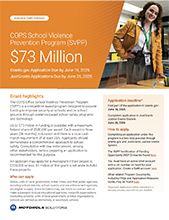
Access expert grant assistance to enhance school safety. Equip your campus with the technology and private networks needed for a secure environment.

Cybersecurity
grants
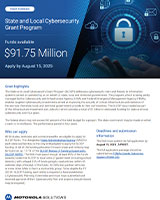
Defend your network with cybersecurity grants. Implement robust threat detection technology to safeguard your data and critical assets.
Understanding types of government-funded grants
Identifying the various grants is the first step in securing funding. Federal and state governments are the
biggest sources of grant money.
Federal government grants
Managed at the national level, federal grants provide the largest funding pools. These awards require strict reporting and audits to ensure compliance.
State government grants
State grants often act as pass-through funding for local priorities. These regional awards can have smaller budgets and fewer reporting restrictions.

Navigating government-funded grants programs: Application tips
Obtaining a grant requires a strategic approach. Follow these best practices to enhance your application
for any government grants program.

Define the operational need
Don't just list equipment; explain the security and technology gap the grant fills, while ensuring the requested amount aligns with allowable costs.

Register early
Secure eligibility as soon as possible: all applicants for federal government funding grants must have an active Unique Entity ID (UEI) via SAM.gov.

Support narratives with data
Justify your application with numbers: use statistics and incident reports to prove the necessity of your project and demonstrate a clear safety gap.

FAQs about government-funded grants
Applying for a government-funded grant involves a structured process of matching your mission to the right funding source. For state grants, search through your state’s agencies for grant programs matching your need, such as departments of homeland security or emergency management. For all federal awards, establish grant readiness by registering your organization at SAM.gov to obtain a UEI.
Both SAM.gov and Grants.gov allow for year-round registration. Having accounts ready early is the best way to avoid a last-minute scramble.
Finally, identify a grant program that aligns with your technology needs, such as security cameras or P25 radios, and carefully review the Notice of Funding Opportunity (NOFO) for eligibility. For expert help in submitting a competitive proposal, access grant research and narrative review from our partner Lexipol.
Your organization can locate federally-funded grants on Grants.gov. Key federal government preparedness grants include:
- Nonprofit Security Grant Program (NSGP): Provides critical funding for target hardening and physical security enhancements to 501(c)(3) organizations.
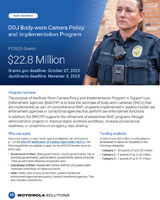
- Homeland Security Grant Program (HSGP): Supports state, local, tribal and territorial efforts to prevent, protect against and respond to acts of terrorism.
- Counter-Unmanned Aircraft Systems (C-UAS) Grant Program: Gives funding to help combat the unlawful use of unmanned aircraft systems (UAS) that pose a threat to the safety and security of the public.
- Assistance to Firefighters Grants Program (AFGP): Funds resources needed to equip and train emergency personnel, enhance efficiencies and support community resilience.
Beyond the level of government (federal or state), grants are categorized by how they are awarded.
- Competitive (discretionary) grants: Awarded based on the merits of a submitted proposal. Projects are scored by a selection panel.
- Non-competitive (mandatory) grants: Awarded to all eligible applicants who meet specific criteria. This category includes:
- Formula grants: Distributed based on statistical data (like population or income levels).
- Block grants: Large sums given to states for broad purposes, offering more local flexibility.
- Categorical grants: Funds restricted to a very specific, narrowly defined purpose.
Eligible applicants vary by grant program but may include state, tribal and local governments, transit providers, universities, research labs, nonprofit organizations, law enforcement agencies, businesses and others.
Your organization can locate state funded security grant programs by looking into your state’s homeland security, emergency management and/or state police websites. For some school safety grants, check with your state’s department of education. Please note that some federally funded grants “pass through” to state agencies for distribution. Depending on the federal program, there is a State Administrative Agency (SAA) to correspond, take applications, and distribute funds. Contact your state’s SAA for that federal agency to get the best information on how to apply for those “pass through” funds.