
Smart Command And Control Center
Integrated Safety and Security Command Center.
Delivers a robust and integrated safety and security framework, empowering organisations to proactively monitor, respond to, and mitigate risks using their radio systems.
Learn MoreDescription
Smart Command Control Center (SC3) is a robust control room solution designed to work with TETRA, DMR, P25, and LTE systems of any size and complexity. The SC3 system offers a wide choice of modules which can be tailored to individual requirements.
Industry
- Agriculture, Airlines and Airports, Border and Coastal Security, Education, Electricity, Emergency Medical Service (EMS), Emergency Response, Facilities Management and Private Security, Fire, Forestry, Healthcare & Hospitals, Industrial Installation & Repair, Internet, Cable & Telecom Service Providers, Military and Defense, Oil and Gas - Petrochemical, Parcel & Freight Services, Prisons & Corrections, Professional and Commercial Radio Network Operators, Public Transit, Public Works, Water & Sewage, Railways and Railroad Operations, Warehouse & Storage
- Enhanced Situational Awareness: Real-time GPS tracking of all mobile units provides a comprehensive overview of asset locations.
- Faster Incident Response: Immediate alarm reception from diverse locations (buildings and vehicles) enables quicker awareness and response to critical events.
- Improved Accountability and Evidence: Voice recording of all communications offers a valuable audit trail for incident analysis and dispute resolution.
- Proactive Security and Intelligence: Video analytics provides advanced monitoring capabilities for threat detection, identification, and security management.
- Unified Communication: The dispatcher module centralises voice communication across different radio networks, streamlining coordination.
- Increased Staff Safety and Efficiency: Indoor tracking allows for monitoring staff locations within buildings, improving safety and operational awareness.
- Comprehensive Monitoring: A single platform integrates tracking, alarms, voice, and video, offering a holistic view of operations and security.
- Data-Driven Insights: The collected data (location, alarms, recordings, video analytics) can be used for analysis, reporting, and process improvement.
- Scalability and Flexibility: The modular design allows users to leverage the features most relevant to their needs and potentially expand as required.
- Centralised Control: A single application provides a central point for managing and responding to various events and communicating with different teams.
- GPS Tracking for All Movable Units:
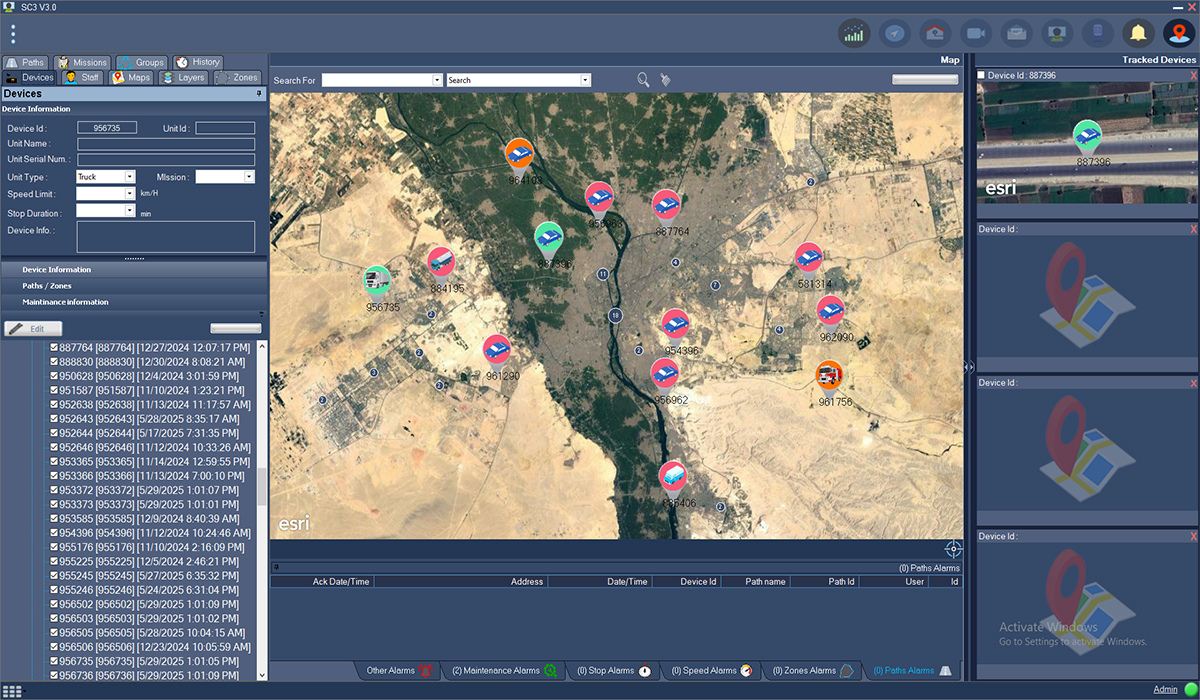
Real-time Location Monitoring: Displays the current geographical position of all tracked vehicles (cars, trucks, buses, motorcycles) on a map interface.
Historical Tracking: Allows users to view the past routes and locations of movable units over a specified period.
Geofencing: Enables the creation of virtual boundaries (geofences) and generates alerts when a unit enters or exits a defined zone.
Speed Monitoring: Tracks the speed of vehicles and triggers alerts for speeding violations.
Idle Time Monitoring: Detects and logs periods when vehicles are stationary for longer than a defined duration.
Route Management: Allows for the creation and assignment of planned routes to vehicles.
Point of Interest (POI) Management: Enables the creation and marking of important locations on the map.
Reporting and Analytics: Generates reports on vehicle movement, mileage, stops, and other relevant data.
- Alarm Module:
Unified Alarm Reception: Receives alarm notifications from various sources:
Buildings: Banks, gas stations, schools, factories, etc. (details of alarm types not specified, but could include intrusion, fire, panic, etc.)
Vehicles: Money transfer trucks, gas trucks, prison buses, school buses, etc. (likely including duress, location-based triggers, tampering, etc.)
Real-time Alarm Display: Presents incoming alarms with critical information (location, source, time, type) in a clear and prioritised manner.
PSIM Integration: SC3 Alarm server can integrate with any Physical Security Information Management (PSIM) system, enabling centralised management and control of all alarms and notifications.
Alarm Prioritisation: Allows for the categorisation and prioritisation of alarms based on severity and source.
Customisable Alarm Rules: Enables the configuration of rules for triggering and handling different types of alarms.
Alarm Acknowledgement and Escalation: Provides mechanisms for users to acknowledge alarms and escalate them to relevant personnel if needed.
Alarm History and Logging: Maintains a comprehensive log of all received and handled alarms for review and analysis.
Geographic Alarm Association: Displays the location of the alarm on the map interface.
Integration with Other Modules: Potentially integrates with GPS tracking to pinpoint the location of vehicle alarms and with the video module for visual verification (if cameras are present at the alarm location).
- Voice Recording Module:
Automatic Voice Chat Recording: Continuously records all voice communications occurring within the system across different talk groups and networks.
Secure Storage: Stores recorded audio files securely with appropriate timestamps and metadata (e.g., talk group ID, participants).
Search and Retrieval Functionality: Allows authorised users to search and retrieve specific voice recordings based on various criteria (e.g., date, time, talk group, participants).
Playback Controls: Provides standard audio playback controls (play, pause, rewind, fast forward).
Audit Trail: Logs access and actions performed on the recorded voice files for security and accountability.
Configurable Retention Policies: Allows administrators to define how long voice recordings are stored.
- Video Module:
Centralised Video Management: Provides a single interface for managing and viewing video feeds from various sources (analog and digital cameras).
Video Recording and Storage: Supports continuous or event-triggered recording with configurable storage capacity.
Video Playback and Review: Enables users to play back recorded video footage with timeline navigation and search capabilities.
Video Analytics Integration: Incorporates advanced video analytics features:
Face Recognition: Identifies individuals based on facial features.
Monitoring Zones: Detects activity within predefined virtual areas.
Object Detection: Identifies specific objects (e.g., people, vehicles, packages) within the video feed.
License Plate Recognition (LPR): Automatically identifies license plates of vehicles.
Real-time Video Monitoring: Displays live video feeds from connected cameras.
PTZ Camera Control: Allows users to remotely pan, tilt, and zoom Pan-Tilt-Zoom (PTZ) cameras.
Event-Based Recording and Alerting: Triggers recording and generates alerts based on detected video analytics events.
- Dispatcher Module:
Multi-Network Communication: Enables dispatchers to communicate with different voice talk groups operating on various radio networks (TETRA, DMR, P25, LTE) from a unified screen.
Intuitive User Interface: Provides a clear and organised interface for managing and participating in multiple voice channels.
Talk Group Management: Allows dispatchers to select and monitor different talk groups.
Individual and Group Calling: Supports both one-to-one and one-to-many voice communication.
Presence Awareness: Displays the availability status of users on different networks (if supported by the underlying networks).
Call Prioritisation and Preemption: Enables dispatchers to prioritise critical communications and potentially interrupt lower-priority calls.
Integration with Location Services: Displays the location of communicating units on the map.
Logging of Voice Dispatch Activity: Records details of voice calls made and received by dispatchers.
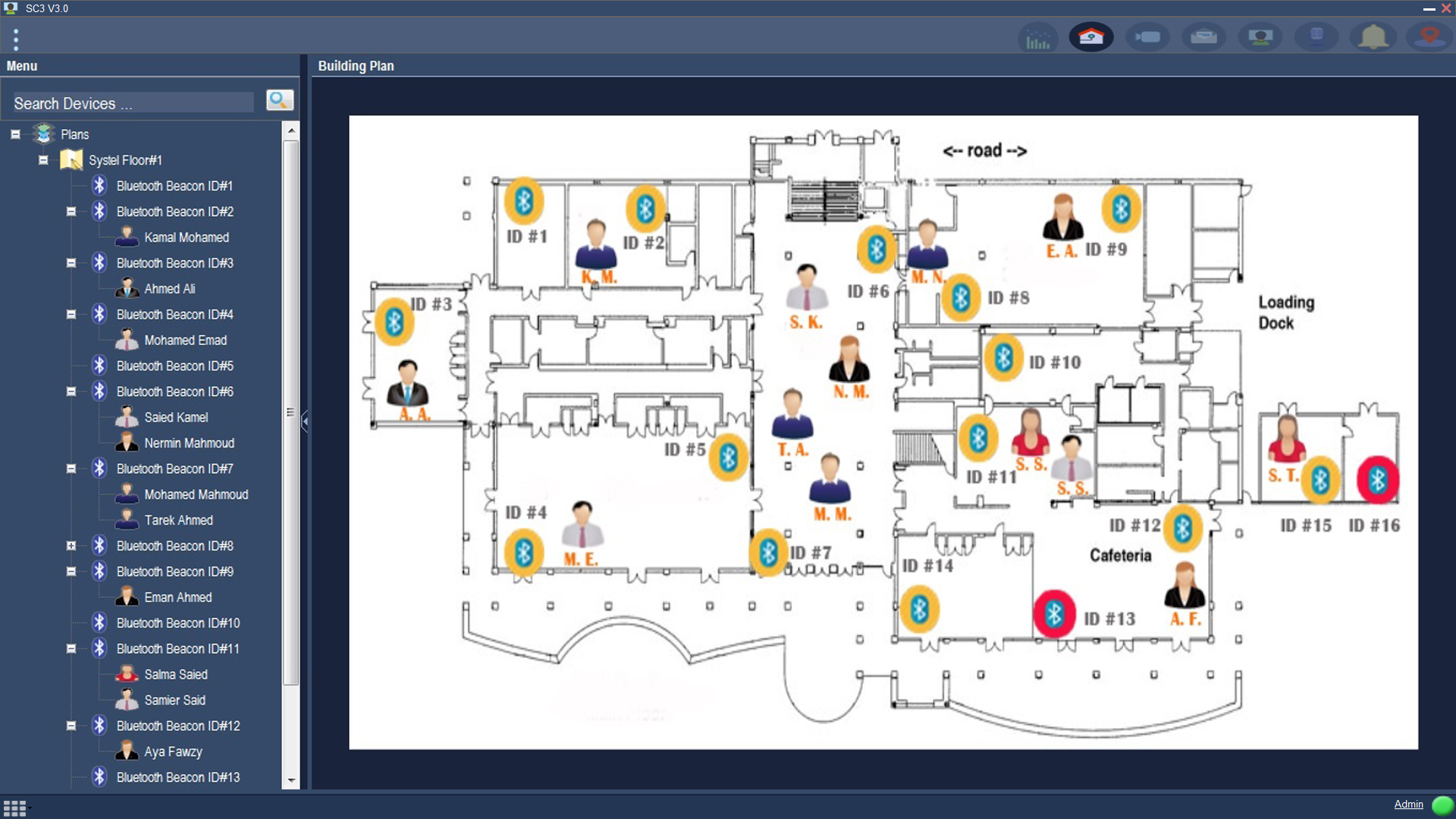
- Indoor Tracking Module:
Staff Location Tracking: Monitors the real-time location of personnel within buildings.
Bluetooth-Based Positioning: Leverages Bluetooth technology integrated into staff radios and strategically placed beacons within the building layout.
Building Layout Visualisation: Displays staff locations overlaid on digital building floor plans.
Zone-Based Tracking and Alerts: Allows for the definition of indoor zones and triggers alerts when staff enter or exit specific areas.
Emergency Location Identification: Enables rapid identification of the location of staff in emergency situations.
Activity Monitoring (Potential): Could potentially track staff movement patterns and time spent in different areas (depending on the granularity of the Bluetooth tracking).
Integration with Dispatcher Module: Allows dispatchers to see the indoor location of staff they need to communicate with.
- Computer Hardware/Operating Systems
Win 11 , Intel core I9 , 16G Ram , 1Tb SSD
- IP Technology
Requires IP connection to SDR
- Interfaces
Or requires RS232 interface to receive alarms.