

When choosing a two-way radio system, one of the most important decisions is whether to use Ultra High Frequency (UHF) or Very High Frequency (VHF) radios. Understanding the difference between UHF and VHF radios can help organizations improve communication reliability, coverage and worker safety across different environments.
In this blog, we’ll compare UHF and VHF radios, explain the pros and cons of each and help you determine which option best suits your operational needs.
What are UHF and VHF radios?
Very High Frequency (VHF) radios operate on frequencies between 30 MHz and 300 MHz, while Ultra High Frequency (UHF) radios operate on frequencies between 300 MHz and 3 GHz. Both technologies are widely used across industries including utilities, manufacturing, transportation, aviation, maritime operations and commercial business operations.
While both radio types are designed to support clear and dependable communication, the environments where they perform best can vary significantly. Factors such as terrain, building density, distance and operational requirements all influence whether a VHF or UHF radio is the better fit.
UHF vs. VHF radio: What’s the difference?
The primary difference between UHF and VHF radios comes down to frequency range and how radio waves travel through different environments. VHF signals typically travel farther than UHF in open, outdoor areas with fewer obstructions. Because VHF wavelengths are longer, they can cover wide distances effectively across flat or rural terrain. Below are some reasons why VHF signals travel farther:
- Due to RF physics, higher frequencies experience greater free-space path loss over the same distance.
- The higher the frequency, the shorter the wavelength and the more likely that a wave's energy gets absorbed by atmospheric gases, water vapor or dust.
Below is a quick comparison of UHF vs. VHF radios:
UHF vs. VHF radio
Discover the key differences between UHF and VHF radios.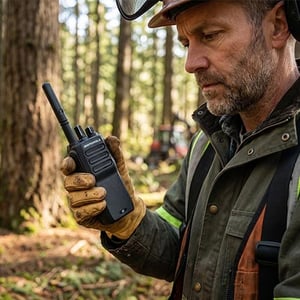

Feature
VHF radios
UHF radios
Frequency range
30-300 MHz
300 MHz-3 GHz
Best environment
Open outdoor areas
Indoor and urban environment
Signal behavior
Longer range outdoors
Better obstacle penetration
Ideal terrain
Rural and forestry
Warehouses, cities & buildings
Antenna size
Typically longer antennas
Typically shorter antennas
Building penetration
Limited
Strong
Use cases
Agriculture
Hospitality
Organizations comparing VHF vs. UHF radios should evaluate where communication will occur most frequently. While both types offer reliable communications, open environments with minimal interference generally favor VHF radios, while dense indoor environments are often better suited for UHF communication.
Pros and cons of VHF radios
VHF radios are commonly used in industries that require reliable communication over long distances outdoors.
Advantages of VHF radios
- Excellent communication range in open outdoor environments
- Effective across rural landscapes and flat terrain
- Can require fewer repeaters in wide-open spaces
- Strong performance in forestry, agriculture and utility operations
Limitations of VHF radios
- Signals can struggle in dense urban areas
- Reduced performance inside buildings and concrete structures
- Longer antennas may be less practical for some users
Common VHF radio applications
VHF radios are widely used across:
- Airport/seaport operations
- Forestry and natural resource industries
- Agriculture and farming
- Utility services
Pros and cons of UHF radios
UHF radios are designed to perform well in environments where physical obstructions may interfere with communication.
Advantages of UHF radios
- Better signal penetration through walls and concrete
- Improved communication inside buildings and urban environments
- Strong performance in multi-level facilities
- Typically smaller antennas
- More effective in crowded RF environments
Limitations of UHF radios
- Shorter range in wide-open outdoor environments
- Signals can attenuate more quickly over long distances
- May require additional repeaters for expansive outdoor coverage
- Performance can vary depending on terrain and infrastructure density
Common UHF radio applications
UHF radios are commonly used in:
- Manufacturing facilities
- Warehouses and distribution centers
- Hotels, hospitality and retail environments
- Schools and campuses
- Construction sites
- Healthcare facilities
- Urban transportation systems
When comparing UHF radio vs. VHF radio performance indoors, UHF is generally the preferred solution due to its ability to maintain communication through obstacles and across multiple floors.
Explore our radios
Dependable communication for every environment:- Indoor/outdoor communication
- Industrial facilities
- Outdoor field operations

Which is better: UHF or VHF radios?
The answer depends entirely on your operational environment and communication priorities.
Choose VHF radios if you need:
- Long-range outdoor communication
- Coverage across open rural terrain
- Fewer repeaters for wide-area coverage
- Communication across farms, forests or remote infrastructure
Choose UHF radios if you need:
- Reliable indoor communication
- Signal penetration through walls and structures
- Communication in cities or industrial environments
- Multi-floor building coverage
Organizations often compare UHF vs. VHF radios when evaluating communication systems for specific industries.
Hotels
Hotels and hospitality environments commonly rely on UHF radios because their shorter wavelengths offer better signal penetration through walls and across multi-level facilities for reliable indoor communication.
Manufacturing and industrial operations
Factories, warehouses and industrial facilities commonly favor UHF radios for their ability to maintain reliable communication through machinery, concrete walls and complex infrastructure.
Utilities and field services
Utility crews operating across remote outdoor infrastructure often benefit from VHF radio systems that provide extended outdoor coverage.
Education
Schools and large campuses benefit from UHF radios because their signals reliably penetrate walls and multiple floors, which is essential for staff communication and safety.
Finding your best fit: UHF and VHF
Understanding the difference between UHF and VHF radios is essential when building a dependable communication strategy. VHF radios are typically best for long-range communication in open outdoor environments, while UHF radios excel in indoor settings and urban areas where signal penetration is critical.
When comparing VHF vs. UHF radios, there is no universal “best” option, only the best fit for your environment, workforce and operational goals. By evaluating terrain, infrastructure and communication needs, organizations can select the radio solution that delivers reliable coverage, improved coordination and enhanced worker safety.
Ready to find the right radio for your organization? Contact a Motorola Solutions expert today.