
Trusted by 100,000+ organizations globally








Creating a safe learning environment has become one of the highest priorities for schools across North America. From unauthorized visitors and vandalism to bullying, theft and emergency situations, today's educational institutions face a wide range of security challenges that require proactive planning rather than reactive responses.
While no technology can prevent every incident, school security cameras have become an essential part of modern campus safety. Some believe cameras invade privacy or simply record events after they happen. In reality, modern school security camera systems can help administrators make faster, more informed decisions while supporting a comprehensive school safety strategy.
This guide explains how security cameras for schools work, explores the different camera types available, discusses best practices for implementation and outlines the key features schools should consider before investing in a new system.
The campus threat landscape in 2026
Schools today face increasingly complex security concerns that extend beyond traditional physical threats. Administrators are expected to protect students, staff, visitors and property while maintaining an open, welcoming educational environment.
Common security challenges include:
- Unauthorized campus access
- Vandalism and property damage
- Bullying and student altercations
- Theft of school equipment
- Vehicle-related incidents in parking areas
Additionally, many districts are expanding campuses, upgrading technology infrastructure and managing multiple school buildings with limited security personnel. This makes real-time visibility across facilities increasingly important.
Modern video surveillance in schools helps administrators monitor activity across campuses without requiring additional personnel at every location. When integrated with other security technologies, surveillance systems can improve awareness, accelerate investigations and support coordinated emergency response.
Need help choosing the right cameras?
Our experts can help you design a customized security ecosystem for your campus.
-
Advanced AI analytics
-
End-to-end video security
-
Integrated VMS and access control
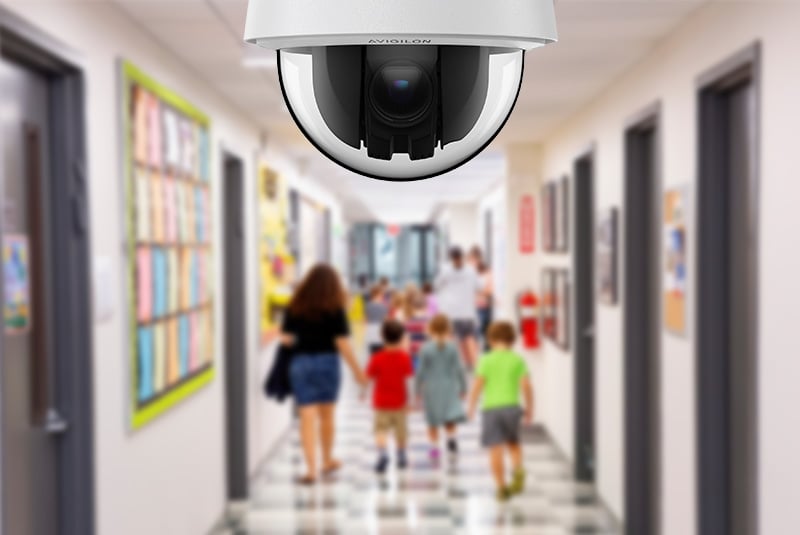
Why are security cameras important for schools?
Schools are responsible for protecting hundreds, or even thousands, of students and staff everyday. When incidents occur, having accurate information quickly can make a significant difference in response efforts. Rather than replacing security staff, school surveillance cameras provide another layer of visibility that helps administrators monitor campus activity in real time.
Most importantly, surveillance systems contribute to a safer learning environment where educators can focus on teaching instead of constantly worrying about security concerns.
Key benefits of school security cameras
A properly designed school security camera system offers benefits before, during and after an incident.
Safeguard students and staff
Surveillance provides administrators with greater visibility across classrooms, hallways, entrances, playgrounds, cafeterias and athletic facilities, helping identify situations that require assistance.
Detect incidents and verify building access
Modern school cameras can identify unusual activity such as loitering after school hours, crowd formation or restricted-area entry. When integrated with access control systems, cameras help confirm who entered specific doors, whether credentials were used appropriately and whether unauthorized individuals attempted entry. Security personnel receive alerts sooner, allowing faster intervention.
Deter crime
Visible security cameras in schools often discourage vandalism, trespassing, theft and other unwanted behavior simply by increasing accountability.
Preserve video evidence
One of the most valuable benefits of school security camera footage is objective documentation. Recorded video can help resolve disputes, investigate incidents, verify timelines and support law enforcement when appropriate.
Improve emergency response
During emergencies, security personnel can view live video feeds to better understand unfolding situations and direct responders more effectively.
Support operational efficiency
Surveillance extends past security. Schools often use video systems to:
- Monitor facility usage and identify maintenance concerns
- Improve traffic flow during drop-off and pick-up
- Observe visitor movement
- Evaluate evacuation procedures
Get our free school safety guide
Download our comprehensive checklist to evaluate your campus safety and prioritize key security upgrades.
-
Identify campus security blind spots
-
Align with safety best practices
-
Prioritize essential technology
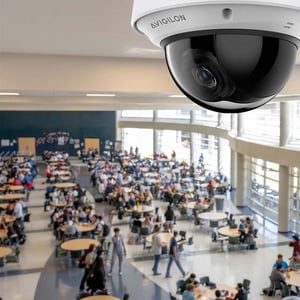
Types of school security camera systems
Different areas of a campus require different surveillance technologies. Most schools benefit from using multiple camera types rather than relying on a single solution.
AI security cameras
AI-powered cameras automatically analyze video to detect people, vehicles, unusual movement, loitering, perimeter breaches, crowd formation or objects left behind. Instead of requiring operators to constantly watch video feeds, AI highlights events that may require attention.
Best for: Entrances, hallways, parking lots and high-traffic areas.
Dome cameras
Dome cameras offer a discreet appearance while providing wide-angle coverage. Their vandal-resistant design makes them one of the most common security cameras for schools.
Advantages include:
- Wide field of view and difficulty in determining viewing direction
- Indoor and outdoor models
- Tamper-resistant housing
Best for: Hallways, classrooms, cafeterias and libraries.
Bullet cameras
Bullet cameras provide long-distance visibility and are ideal for monitoring perimeter areas.
Benefits include:
- Longer viewing distances
- Excellent outdoor performance and weather-resistant construction
- Easy visual deterrence
Best for: Parking lots, building exteriors and athletic fields.
PTZ (Pan-Tilt-Zoom) cameras
PTZ cameras allow operators to remotely move the camera, zoom in on activity and monitor large spaces using a single device. They work especially well during school events where crowds gather.
Best for: Stadiums, gyms, parking lots and large courtyards.
Fisheye cameras
Fisheye cameras provide 180° or 360° coverage, allowing schools to monitor large spaces with fewer cameras.
Best for: Cafeterias, libraries and open common areas.
Multi-sensor cameras
Rather than installing multiple individual cameras, multi-sensor panoramic cameras combine several lenses into one housing to monitor multiple directions simultaneously.
Best for: Building corners, intersections and parking lots.
License Plate Recognition (LPR) cameras
LPR cameras automatically capture and recognize license plate numbers.
Schools commonly use them to:
- Monitor visitor vehicles
- Investigate vehicle incidents
- Improve parking security and restrict unauthorized access
School security camera system components
There are several components that create a complete video security solution.
A comprehensive system typically includes:
 Video Management Software (VMS)
Power over Ethernet (PoE) network switches
Secure cloud or hybrid storage
Intelligent video analytics
Video Management Software (VMS)
Power over Ethernet (PoE) network switches
Secure cloud or hybrid storage
Intelligent video analytics
How to choose the best security cameras for your school
Selecting the right surveillance system requires balancing your school's specific safety goals with budget, infrastructure capabilities and long-term scalability. By evaluating key features like video analytics, integration and ease of use, administrators can deploy a solution that effectively protects the campus while supporting educational outcomes.
1. Conduct a campus security assessment
Every campus has different requirements, so system design should begin with a thorough assessment.
Identify:
- High-risk locations and existing blind spots
- Historical incident trends
- Future expansion plans
2. Define your security goals
Your objectives will influence camera selection, placement, storage requirements and software capabilities.
Determine whether your priority is:
- Crime prevention
- Visitor management
- Emergency response
- Incident investigations
- Operational monitoring
3. Select the right camera types
Choose cameras based on the environment rather than purchasing the same model for every location. Using specialized cameras improves coverage while reducing unnecessary equipment.
4. Prioritize image quality
Clear footage is essential for identifying people, vehicles and events during investigations.
Look for cameras that provide:
- High-resolution video
- Wide dynamic range (WDR)
- Low-light performance or infrared night vision
- Fast frame rates
- Weather resistance for outdoor use
5. Evaluate Video Management Software (VMS)
The video management software serves as the central hub of a surveillance system, allowing administrators to view live video, search recordings, manage users, configure alerts and export evidence.
Key features to look for include:
- Intuitive interface
- AI-assisted video search
- Multi-site management
- Mobile access
- Role-based permissions
An effective VMS helps schools quickly locate relevant footage without manually reviewing hours of recordings.
6. Plan strategic camera placement
Proper placement maximizes visibility while respecting privacy.
Recommended locations include:
- Main entrances and exits
- Reception areas
- Hallways
- Parking lots and bus loading zones
- Exterior building perimeters
Avoid placing cameras in areas where individuals have a reasonable expectation of privacy, such as restrooms, locker rooms, health offices or changing areas.
7. Consider future growth
Schools often expand over time and scalability helps protect your investment.
Choose a system that can accommodate:
- Additional cameras or other new security integrations
- Multiple campuses
- Cloud storage
- AI analytics upgrades
8. Integrate other security systems
Modern surveillance is most effective when connected to a greater school safety system. These integrations provide a more complete picture during emergencies while simplifying daily security operations.
Common integrations include:
- Electronic access control
- Visitor management
- Emergency notification systems
- Intrusion detection
- License plate recognition
Common misconceptions about cameras in schools
Despite the proven safety benefits, some stakeholders still harbor concerns about surveillance technology in educational settings. Addressing these common myths is essential for building trust and ensuring the entire community understands the protective value of a modern IP camera system.
Below are some common misconceptions:
Cameras prevent every crime
Cameras reduce risk and improve awareness, but they are most effective as part of a broader security strategy that includes trained staff, emergency planning, access control and visitor management.
School cameras invade student privacy
Schools must balance security with privacy. Cameras are typically installed in public spaces where there is no reasonable expectation of privacy. Clear policies, limited access to recordings and compliance with applicable laws help protect individual rights.
Only large school districts need surveillance
Even small schools experience theft, vandalism, unauthorized access and safety incidents. Modern systems can be scaled to meet the needs and budgets of schools of all sizes.
Video is only useful after something happens
Today's AI-powered systems provide proactive alerts that can help staff respond before situations escalate.
All camera systems are the same
Camera resolution, analytics, cybersecurity, storage, software capabilities and integration options vary significantly between systems. Looking beyond hardware alone helps schools build a solution that meets both current and future needs.
Conclusion
As schools continue to navigate evolving security challenges, surveillance technology has become an important tool for creating safer learning environments. Modern school security camera systems provide far more than recorded video, they support situational awareness, improve emergency response, streamline investigations and integrate with broader physical security solutions.
However, technology is only one component of an effective security strategy. Success depends on thoughtful planning, strategic camera placement, strong cybersecurity practices, clear privacy policies and ongoing staff training.
By selecting scalable solutions that align with their operational goals, schools can better protect students, staff, visitors and facilities while maintaining the welcoming atmosphere that education depends on.
Ready to modernize your school’s security strategy? Contact our campus safety experts today to design a tailored surveillance solution.
Frequently Asked Questions