The complete guide to selecting emergency alerts for your school
.jpg?width=800&height=535&name=emergency-alerts-schools-and-campuses_Hero%20(1).jpg)
From severe weather and medical emergencies to security threats and everyday operational updates, schools need the ability to communicate quickly and accurately with students, staff, parents and first responders. Minutes, or even seconds, can make a significant difference during an emergency.
That’s why emergency alerts have become a foundational part of modern school security strategies. Today’s platforms do far more than send text messages. They enable administrators to detect incidents, coordinate emergency response, deliver targeted communications and provide situational awareness across an entire district or campus.
Whether protecting an elementary school or college campus, the right school alert system helps you ensure the right people receive the right information when they need it.
In this guide, we’ll explore what school alert and notification systems are, how they work, the differences between K-12 and higher education needs and the features schools should look for when evaluating solutions.
A school alert system is a communication platform that enables educational institutions to rapidly send emergency alerts and important notifications to predefined groups during critical situations. These alerts can be delivered through multiple communication channels simultaneously, including:
Unlike traditional communication methods that rely on phone trees or email chains, a modern alert system for schools automates emergency communications, helping administrators notify thousands of recipients within seconds.
Depending on the platform, alerts can be triggered manually by administrators or automatically through integrations with:
The goal is simple: reduce response times while helping to ensure accurate, consistent communication during emergencies.
While often used interchangeably, a school notification system serves a broader purpose than emergency alerts alone. Notification systems handle both emergency and non-emergency communications, allowing schools to engage students, staff, parents, faculty and visitors throughout the school year. Examples include:
Many modern school emergency alert systems combine both notification and emergency management capabilities into a single platform, eliminating the need for separate communication tools.
Educational institutions face a wide variety of safety challenges that require fast, coordinated communication. Some of the most common scenarios include:
Schools can immediately issue lockdown instructions, notify law enforcement, share live updates and provide safety instructions tailored to individual buildings or classrooms.
Administrators can quickly communicate shelter-in-place instructions, delayed dismissals or campus closures due to tornadoes, hurricanes, floods or snowstorms.
Staff can request immediate assistance for cardiac events, allergic reactions or injuries while simultaneously notifying emergency responders and school personnel.
Integrated fire alarms can automatically trigger evacuation notifications while providing administrators with real-time status updates.
Schools can quickly notify staff with descriptions, last known locations and search instructions.
Laboratories, maintenance facilities or even nearby industrial incidents may require evacuation or shelter-in-place instructions for specific buildings.
Modern schools operate in increasingly complex environments. Administrators must respond to emergencies quickly while coordinating multiple stakeholders. An effective school notification system helps schools:
Automated alerts eliminate manual communication delays.
Instead of contacting individuals one time, notifications are delivered instantly across multiple channels.
Consistent messaging prevents rumors and conflicting instructions.
Administrators gain visibility into who's been notified, who’s responded and where additional assistance may be needed.
Many districts use notification systems to support emergency preparedness requirements, safety planning and incident documentation.
Not all communication platforms offer the same capabilities. The best notification systems combine emergency communication with proactive safety management.
Schools should be able to send alerts through:
Using multiple channels increases the likelihood that recipients receive time-sensitive information.
Rather than notifying everyone, administrators should be able to send alerts based on:
This minimizes confusion while helping to ensure relevant audiences receive actionable information.
A dedicated emergency alert and notification system allows users to:
Mobile apps make safety resources readily available wherever students and staff are located.
Modern systems allow recipients to:
This improves situation awareness during evolving events.
The best platforms integrate with:
These integrations automate emergency workflows and reduce manual effort.
Motorola Solutions offers a connected portfolio of safety technologies designed to help educational institutions prepare for, respond to and recover from emergencies.
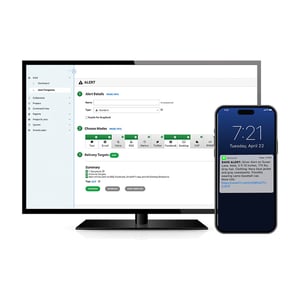
A leading school emergency alert system that enables schools to rapidly send notifications across multiple channels.
AppArmor provides customizable emergency alerts that connect students, faculty and staff with safety resources through a mobile experience.
Organizations can provide:
Motorola Solutions expands emergency preparedness with integrated communication, incident management and public safety capabilities.
Effective communication is one of the most important components of any school safety strategy. Whether responding to an active threat, severe weather, a medical emergency or simply notifying parents about a schedule change, schools need reliable tools that deliver timely, accurate information.
Modern notification systems combines emergency alerts, routine notifications, mobile safety tools and incident management into a single connected platform. From K-12 districts focused on parent communication to universities managing large, distributed campuses, the right school alert system helps improve response times and keep communities informed.
Solutions such as Rave Alert, AppArmor and the broader Rave platform provide schools with flexible technologies that support emergency preparedness, strengthen communication and help create safer learning environments for students, educators and staff alike.
To learn more about our school and campus safety solutions, Contact sales.