
.jpg?width=800&height=535&name=Retail-comms-guide_Hero%20(1).jpg)
A thriving retail floor operates on a precise rhythm: associates move with purpose, customers receive immediate answers and shelves remain stocked while checkout lines move before they can form. This seamless coordination is the result of an effective retail communication strategy.
What is retail communication? At its core, it is the heartbeat of daily operations, connecting the merchandiser who designs the floor plan to the associate stocking shelves, and linking the corporate office tracking regional metrics to the store manager leading morning meetings. Most importantly, it connects customers with the support they need, when they need it.
When communication in retail flows naturally, associates know what to do next and customers get answers instantly, allowing the entire store to move faster. When it breaks down, the effects appear immediately as empty shelves, long lines and frustrated teams. Online shopping offers speed and convenience, but the physical store's advantage lies in real-time human connection, built and sustained by retail communications technology.
Types of retail communication
To understand how to improve the storefront experience, it helps to break down how information moves. When looking at retail communication in a modern business, the concept falls into two primary categories. While each requires a different approach, they must work together to build a strong brand experience.
When both channels function flawlessly, the storefront operates like a finely tuned machine. If either side breaks down, the friction is felt immediately by staff and guests alike. Understanding the distinct dynamics of these two categories allows owners to target their operational improvements effectively.
Internal communication
Internal communication is the network of messages, updates and directives shared within the business. This includes conversations on the sales floor, shift handovers between managers and updates communicated from corporate headquarters, covering everything from safety alerts and inventory checks to training videos and task lists. When internal communication works, it keeps everyone aligned, turning a group of hourly workers into a cohesive team that understands how to hit daily targets.
This internal layer is the foundation of daily operations. A change in pricing at the corporate office translates to the correct tag on the shelf within minutes, and a part-time associate gains the exact knowledge needed to speak confidently about a product. Without strong internal channels, the store floor becomes chaotic and leaves employees guessing at their duties, while creating gaps in execution that could harm performance.
External communication
External communication is how the store connects with the outside world. This includes interactions between associates and shoppers on the floor, marketing emails sent to loyalty members and signs displayed in windows, along with customer service chats, curbside pickup notifications and social media responses. External communication shapes how people feel about a brand before they step inside, and determines whether they will return after they leave.
This public-facing dialogue is where brand promises are tested in real time. Every piece of external outreach sets an expectation, and when an associate greets a customer with the exact information promised in a recent marketing email, the loop closes perfectly. Managing this side of retail communication effectively requires giving floor teams real-time visibility into what the public sees, so the human interaction matches the digital advertisement.
Connect your floor instantly
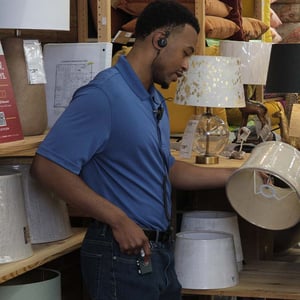
Theatro empowers retail teams with voice-driven wearable devices for instant data and seamless store coordination.
- Heads-up and hands-free voice control
- Instant access to inventory data
- Seamless reach to every department
The invisible friction on the sales floor
Even with the best intentions, communication in retail often runs into significant roadblocks. The modern storefront is loud, fast and constantly changing. This creates distinct challenges that slow down teams and may hurt the bottom line. Without a clear retail communication strategy, even small gaps in information can snowball into lost sales and frustrated teams.
- The corporate disconnect: Messages from the main office often arrive as long, text-heavy emails, but deskless workers do not have time to sit in a back room and read through bullet points between customers. They need short, actionable highlights they can use right away, delivered in a format that fits the pace of the floor rather than the pace of an office inbox.
- Information silos: Departments frequently work in isolation, with each holding pieces of information that the rest of the store needs. The stockroom team might know a shipment is delayed, but if that information does not reach the floor, associates will keep searching for items that are not there, wasting time and frustrating customers in the process. Without a shared view of what is happening across the building, even small disruptions multiply.
- The game of telephone: When updates pass verbally from a regional director to a store manager, then to a shift lead and finally to an associate, the core message changes, and the original intent gets lost along the way. By the time a directive reaches the floor, it may be missing the urgency or the deadline that made it matter in the first place.
- An overwhelmed workforce: Workers constantly balance customer service, inventory tasks and safety procedures, and when too many alerts are launched at once, critical messages get lost in the noise. A constant stream of low-priority pings trains associates to tune out, which means the one urgent message that truly matters can go unnoticed.
These challenges show why communication in retail cannot rely on outdated habits. Retail communications technology exists to close these gaps, replacing scattered, inconsistent updates with a system built for the speed and pressure of the sales floor.
How retail communications technology bridges the gap
Fixing friction on the sales floor requires moving away from heavy text chains and paper logs. Modern retail communications technology is designed to put answers where the action is: in the hands and ears of the frontline team. When a store upgrades its digital tools, the entire dynamic of the floor changes, since employees stop running back and forth for answers and managers spend less time policing tasks. The technology works quietly in the background and turns chaotic shifts into smooth, predictable workflows.
Instant voice connection
Two-way business radios offer instant, voice-based connection across the entire layout, so an associate at the fitting room can check on a different size without leaving the customer side, turning a potential walk-out into a confirmed sale.
This instant reach removes the need to shout across aisles or hunt down a manager for basic approvals, creating a professional environment where information moves instantly and the focus stays entirely on the shopper's needs.
Intelligent routing and hands-free data
Advanced voice platforms take this concept further. Instead of open channels where everyone hears every conversation, these intelligent platforms use small, wearable devices driven by voice commands, so associates can talk directly to specific departments, ask an automated bot for real-time inventory levels or connect with a manager instantly.
The technology handles the routing so the employee can keep their eyes on the shopper. This specialized approach to communication in retail keeps valuable sales data just a quick voice command away.
Digitizing daily tasks
Smart software applications bring corporate goals directly to the floor. Mobile apps turn complex operational rollouts into simple, bite-sized tasks, so associates see exactly what needs to be done during a shift, snap a photo when completed and log out.
This gives managers instant visibility while empowering teams to operate autonomously. Once these tools become part of the daily routine, retail communications turn into a natural byproduct of doing the work rather than adding an extra chore for staff.
Frontline safety and training
Body cameras are also becoming an essential tool for retail support. Beyond loss prevention, these devices capture real-time footage during critical incidents or safety threats.
They give teams an objective record of events, help de-escalate tense interactions and provide clear visual data to improve future safety training. Paired with smart software, these tools build a complete picture of the storefront environment and lay the foundation for a safer, more connected workplace where employees can thrive.

View solution
Smart Wi-Fi business radio
The Curve business radio connects your store instantly with voice capabilities that keep your floor team moving.
View solution
View solution
Voice-driven mobile wearable
The Theatro wearable empowers floor teams with instant inventory data and seamless store coordination.
View solution
View solution
Frontline security camera
The SafetyCam body camera protects your floor staff and de-escalates tense customer situations with video capture.
View solutionBuilding a retail communication strategy
Technology is only as good as the plan behind it. To create a highly productive environment, store leaders need a clear retail communication strategy built around human habits, not corporate checklists. If a workflow feels like an administrative chore, staff will find workarounds. A successful plan removes friction and makes connection an effortless part of the workday.
Create one central communications hub
Teams should not have to look in five different places for updates. Eliminating the combination of paper clipboards, personal texting groups, breakroom corkboards and outdated internal portals starts with choosing one primary platform where all official information lives. When employees know there is only one source of truth, they check it more reliably and spend less time searching for answers.
This centralization also removes ambiguity. When a policy changes or a recall occurs, there is no debate over which version of the rule is current, since a single digital hub keeps the entire store network aligned on the same exact page at the same exact time.
Encourage bottom-up communication
Great ideas rarely start in a corporate boardroom. They come from the people who talk to customers every single day, which is why a strong retail communication strategy includes a clear, easy way for customer-facing associates to share feedback upward. When a specific product layout causes confusion or a new policy slows down the checkout line, that insight needs an open path to leadership.
Listening to the floor improves operations and makes teams feel respected. When associates see their real-world observations turning into actual operational changes, their engagement grows, and they stop viewing themselves as shift workers and start operating as stakeholders in the success of the storefront.
Tailor the audience for every message
Not every piece of news applies to every person, and sending a specialized visual merchandising update to an entire delivery team can create digital fatigue. Grouping messages by role, shift or department keeps communication in retail highly targeted, so when an associate hears an alert, they know it matters directly to their work.
Filtering the alerts protects a team's focus, because employees know that when their device alerts them, the message requires immediate attention. That discipline respects their time and keeps their energy focused entirely on the customer experience.
Where connection meets the bottom line
At the end of the day, retail communication is not about the software installed or the devices clipped to a belt. It is about removing the friction that stands between a team and a great day of work.
When associates have the ability to connect instantly, the stress of the unknown disappears. They no longer have to guess at an answer or walk away from a customer to find help, so they can deliver outstanding service and keep the floor moving seamlessly. The power of a connected storefront is in creating an environment where technology supports the team, the team supports the customer and the business naturally grows.
A strong retail communication strategy is not a one-time project. It is an ongoing commitment to the people who keep the floor running every day. As stores add new tools, train new hires and adjust to seasonal demands, the systems behind communication in retail need to adapt along with them.
Retail communications technology works best when it disappears into the background, leaving only the result: confident associates, satisfied customers and a storefront that performs at its full potential.
See how Motorola Solutions helps retail teams stay connected where it counts. Request a demo.