Police drones in 2026: The complete guide to law enforcement UAS
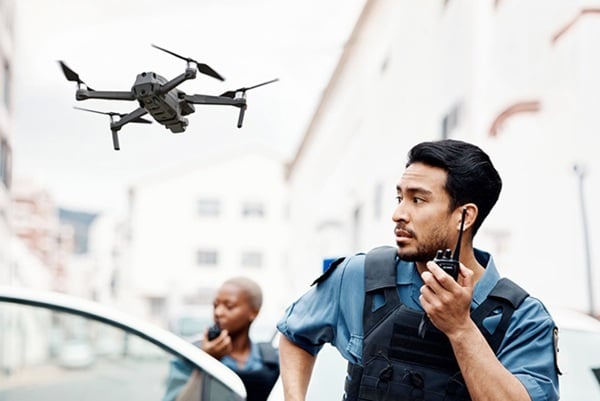






Drone technology has permeated nearly every sector of society. Yet its impact on law enforcement has been particularly transformative.
Once a niche tool, drone technology in policing has seen explosive growth. In 2020, the Center for the Study of the Drone at Bard College reported that only 559 municipal police departments acquired drones. Fast forward to today. According to the EEF Atlas of Surveillance, more than 1,500 law enforcement agencies operate drone programs.
Operational advantages explain the surge. Police departments continue to grapple with significant staffing issues.
For these forces, drones provide a more efficient way to dispatch and manage their teams. A cost-effective alternative to traditional aviation, drones routinely reach critical scenes faster than ground units. Once there, they deliver strategic aerial overwatch. This birds-eye perspective bridges the intelligence gap between dispatch and arrival.
Police forces are not only using the technology for data collection. The technology also acts as a force multiplier. Drone 2.0 deployments even enable departments to patrol without physical bodies.
For law enforcement agencies considering these programs, this article explores the brief history of police drones, current tactical applications and proven recommendations for a successful implementation – from navigating regulatory frameworks to choosing the right fleet.
Learn how responsible AI reduces administrative burdens, unifies public safety data and restores your workforce.
A police drone is an unmanned aircraft system (UAS) used by law enforcement to support tactical operations and public safety.
The drone itself refers to the unmanned aerial vehicle (UAV). However, the FAA defines a UAS as the entire system required for flight. That system includes three basic components:
Many agencies begin with “off-the-shelf” commercial models. Increasingly, departments are transitioning to purpose-built tactical drones. These drones can vary in size and capability. The three most common types include:
Beyond their physical builds, all tactical drones share a suite of mission-critical features – from encrypted streaming to tactical communication:
Equipped with high-definition thermal sensors, tactical drones detect infrared energy to locate missing persons or suspects in total darkness just from their heat signatures.
Many drones also use low-light sensors for identification. These sensors magnify tiny amounts of ambient light to provide clear, natural-looking visuals. For low-light operations, these visuals enable officers to pick up details that thermal heat maps might miss.
The integration of drones into law enforcement began as early as the 2000s. But the industry’s seminal moment came with the 2012 FAA Modernization and Reform Act.
This landmark legislation mandated that the FAA integrate unmanned systems into the national airspace system by 2015. It also simplified the Certificate of Waiver or Authorization (COA) process. This step allowed local law enforcement to self-certify their pilots and more efficiently obtain legal flight authority.
Early law enforcement deployments were often of military-grade UAVs. A prime example is the Mesa County Sheriff’s Office in Colorado. The agency is one of the first to use drones for search and rescue (SAR) and crime scene mapping.
Their pioneering aircraft, the Falcon, was designed by Chris Miser, a former Air Force captain. After service, he transitioned from military drone development to founding a civilian-focused company.
Between 2016 and 2017, the number of agencies with drone programs doubled. As the hardware became more affordable and easier to pilot, drones transitioned from specialized tools used by large departments to standard equipment for municipal policing.
As recently as 2018, public safety drone use was limited to a few applications. The technology has evolved, expanding into most facets of modern policing:
The Chula Vista Police Department’s introduction of DFR in 2018 transformed how law enforcement used tactical UAS.
DFR is proactive, unlike traditional, reactive uses of the technology. Drones are stationed on rooftops, often surveilling miles-long jurisdictions for law enforcement.
The drone launches when a 9-1-1 call comes in, often arriving minutes before ground units. This allows commanders to observe the scene in real time. With this intelligence, they can often de-escalate situations or cancel unnecessary officer deployments.
This use has been a game-changer. The Chula Vista PD reported that drones responded to critical incidents in about 3.5 minutes. Patrol calls took more than double the time.
In the first six months of its DFR program, the Lakewood Police Department recorded that drones arrived first on scene 80% of the time and contributed to 131 arrests in six months.
Drones eliminate the risk of moving forward blindly. As a SWAT team advances, a UAV provides constant overwatch. It streams real-time intelligence from behind fences or inside confined areas. Using both visual and thermal sensors, the drone delivers versatile situational awareness during day or night operations.
For example, in Campbell, California, a 12-hour standoff ended peacefully when a drone spotted tear gas leaking from a kitchen vent. This allowed the SWAT team to adjust tactics and force the suspect to surrender.
In Braintree, Massachusetts, a drone monitored an armed suspect during a five-hour standoff. The critical intelligence it relayed led to peaceful surrender.
Traditional SAR requires line of sight and proximity, whether from acoustic sensors, optical cameras, infrared (heat sensing) cameras or trained dogs. Drones equipped with thermal imaging can blanket miles of impassable terrain in adverse weather to locate missing persons in need of aid.
In the military, reconnaissance means preliminary observation or research to obtain information for a mission. In policing, standing patrols often provide reconnaissance. These units can be tough to staff given workforce shortages. In their place, drones can act as high-speed scouts:
In 2026, traffic management has become integral to smart city design. Crucial to this transition, drones now act as mobile data centers. They often use AI to classify vehicles, calculate flow rates and analyze trajectories in real time.
Drones capture overhead images from different angles and altitudes. As such, they can monitor the site of the accident without interrupting the flow of traffic.
Drones can also accurately create a 3-D mapping of fatality scenes on major highways within minutes of deployment with higher accuracy than traditional tape measures.
Aerial imagery often provides detailed perspectives that ground-based photos might miss. Therefore, drones can create high-resolution records of crime scenes before contamination.
Beyond scene photography, drones also aid in the search for evidence, safety assessment and examination of sites that are difficult or nearly impossible to reach. Drones transmit images quickly. And so, they can help determine the method of scene examination, improving crime scene management.
Drone technology provides an unmatched field of view during large public events at a fraction of the cost of manned helicopters. By deploying UAVs, police gain enhanced situational awareness. This allows them to spot bottlenecks or medical emergencies in real time.
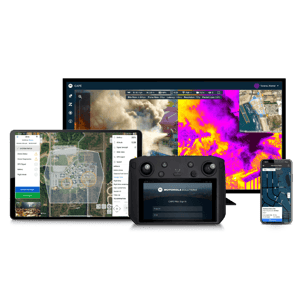
Deploy drone video and flight software to speed response times, gain real-time visibility and protect responders.
Today’s law enforcement agencies operate at a difficult crossroads. They face acute staffing shortages, a more skeptical public and increasing calls for transparency.
On all these fronts, drones have emerged as a critical force multiplier. By enhancing operational efficiency, providing an objective record and allowing for remote de-escalation, drone technology is fundamentally improving how police serve their communities.
As stewards of taxpayer dollars, departments must view a UAS program as a high-stakes investment. This requires a strategic blueprint for long-term viability beyond upfront hardware costs.
We are in the midst of a rapid expansion in law enforcement aviation. The 2025 FAA decision to streamline DFR approval opened the floodgates. Nearly 600 new programs sprang up in four months. With strategic planning and early stakeholder involvement, agencies can prepare for this high-growth trajectory.
The future is bright, driven by the convergence of AI and specialized forensics. Beyond routine patrol and DFR 2.0, public safety is embracing cutting-edge applications like integrated tactical interfaces, merging drone feeds with 3D mapping and mesh radio, and AI assistance. This includes digital partners capable of real-time language translation in the field and automated report drafting from aerial footage.
Ultimately, integrating these advanced UAS capabilities is an industry-changing shift. By enhancing patrol capabilities and increasing operational efficiencies, drones allow officers to move away from blind response and focus on proactive, quality-of-life issues that matter most to the communities they serve.