






Every entrance to a commercial property represents both an opportunity and a security risk. Employees, residents, contractors, vendors, delivery drivers and visitors all need convenient access, but every authorized entry point also has the potential to become an unauthorized one if it's not properly managed.
A modern gate access control system helps organizations strike the right balance between security and operational efficiency. Rather than relying solely on guards or physical keys, today's gate access control solutions verify identities, automate entry permissions, record activity and integrate with the broader security ecosystem. Whether securing an apartment community, corporate campus or industrial facility, the right system allows organizations to protect people and assets without creating unnecessary friction.
This guide explores how commercial gate access control systems work, the technologies available, key features to evaluate and how to choose a solution that can adapt as your property and security needs evolve.
Integrated gate access security
Help protect your site with scalable gate access control that integrates with video security and digital credentials.
- Flexible mobile and RFID credentials
- Automated license plate recognition
- Seamless video security integration
What is a gate access control system?
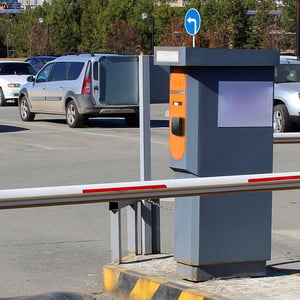
A gate access control system is a security solution that determines who is authorized to enter or exit a secured property through a controlled gate. Instead of leaving entry decisions to manual processes, the system authenticates users using approved credentials before granting access.
Unlike standalone gate operators that simply open and close a barrier, modern gate control systems combine authentication, credential management, automation, monitoring and reporting into a centralized platform. This creates stronger perimeter security while simplifying day-to-day operations.
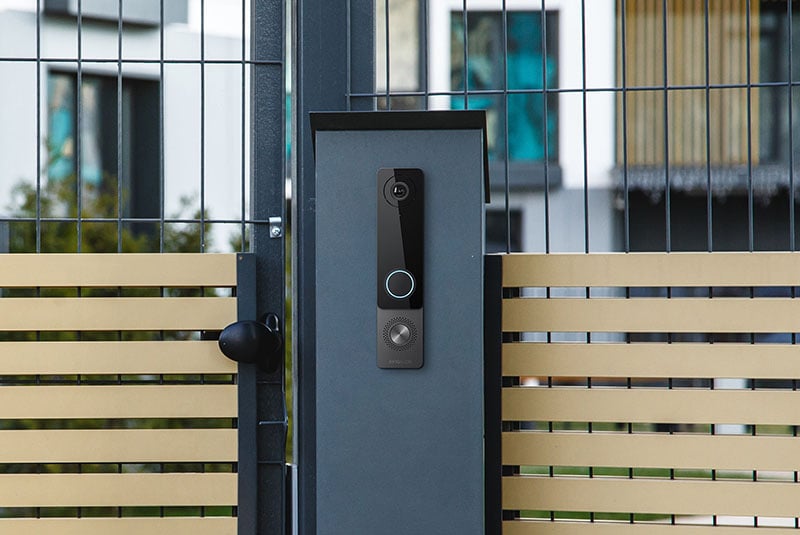
Many organizations also integrate their access control gates with video security, visitor management, license plate recognition and alarm systems to create a unified security environment. Gate access control is commonly used for:
- Commercial office buildings
- Industrial facilities and manufacturing plants
- Distribution centers and logistics yards
- Apartment and multi-family residential communities
Each environment has different operational needs, but they all share the same objective: ensuring only authorized people and vehicles gain access while maintaining an efficient flow of traffic. Perimeter security has become increasingly important as organizations face evolving security risks, larger visitor volumes, hybrid workforces and stricter compliance requirements.
Rather than treating the gate as a standalone asset, organizations are increasingly viewing it as the first layer in a broader security strategy. An intelligent gate security system can help organizations:
- Prevent unauthorized vehicle and pedestrian access
- Reduce dependence on physical keys and manual gate operations
- Improve visibility into who entered, exited and when
- Streamline visitor and contractor access
For many facilities, the gate is the first interaction employees, residents, vendors and visitors have with the property. A modern security gate entry system not only strengthens protection but also improves the overall user-experience.
Benefits of gate access control
The value of commercial gate access control extends well beyond restricting entry. Modern systems provide organizations with better visibility, automation and operational control across their entire perimeter.
Stronger perimeter security
A controlled entrance reduces opportunities for unauthorized access while helping security teams verify every person or vehicle requesting entry. When combined with surveillance and credential management, security gate systems create multiple layers of protection instead of relying on a single barrier.
Improved operational efficiency
Manual gate management often creates delays, inconsistent procedures and unnecessary labor costs. Automated gate entry systems allow approved users to enter quickly using pre-authorized credentials while reducing the need for on-site personnel to verify every request.
This is particularly valuable for:
- Distribution facilities
- Corporate offices
- Apartment communities
- Manufacturing plants
Better visibility and audit trails
Every access event creates valuable operational data. A modern access control system gate can automatically record:
- Entry and exit times
- Credential used
- User identity
- Gate location
Simplified credential management
Traditional keys can be copied, lost or difficult to recover. Digital credentials allow administrators to:
- Add new users remotely
- Modify permissions instantly
- Suspend credentials immediately
- Schedule temporary access
Improved visitor experience
Security shouldn't create unnecessary delays. Modern gate security entry management allows organizations to automate visitor access using temporary credentials, QR codes, video verification or mobile credentials while maintaining security standards. Visitors spend less time waiting, while staff spend less time manually approving entries.
Scalable security for properties
As organizations expand, security requirements evolve. A scalable gate access control system can support:
- Additional entrances
- Multiple facilities
- New credential technologies
- Centralized management
Components of a successful gate control system
A reliable gate control system is made up of several connected technologies that work together to authenticate users, manage permissions, observe activity and automate gate operations. While every property has unique requirements, most systems include the following core components.
Access credentials
These identify authorized users before access is granted. Common credential options include:
- Mobile credentials
- RFID cards
- Key fobs
- PIN codes
- Vehicle license plate information
Credential readers
Credential readers verify identities at the gate. Depending on the property, readers may include:
- Card readers
- Mobile readers
- Keypad readers
- Biometric scanners
Gate operator
The gate operator is the mechanical component that physically opens and closes the entrance after authorization has been confirmed. Gate operators may control:
- Sliding gates
- Swing gates
- Barrier arms
- Vertical lift gates
Access control software
The software serves as the central management platform. Administrators can use it to:
- Manage users
- Configure permissions
- Review activity logs
- Monitor live events
Safety devices
Gate automation should always prioritize safety alongside security. Common safety devices include:
- Vehicle detection loops
- Photoelectric sensors
- Obstruction detection sensors
- Emergency stop buttons
Video security
Many organizations pair their gate security systems with IP cameras positioned at entry and exit points. When integrated with access control, video footage can be linked directly to access events, providing visual verification of each transaction and helping security teams investigate incidents more efficiently.
How does a gate access control system work?
At its core, a gate access control system follows a straightforward process: verify identity, determine authorization and grant or deny access. However, today's commercial gate access control systems go well beyond simply opening a gate. They combine intelligent software, connected devices and real-time observation to help organizations secure their perimeter while keeping traffic moving efficiently.
A typical access event follows these steps:
 1. A user requests access
A driver, employee, resident, contractor or visitor presents an approved credential, such as a mobile pass, RFID card, PIN or license plate.
2. The credential is verified
The credential reader sends the request to the gate access controller, which checks permissions against the access control platform.
3. The system makes a decision
If the credential is valid and the user has permission to enter at that location and time, access is approved. If not, entry is denied.
4. The gate responds
The controller signals the gate operator to open the gate. If access is denied, the gate remains locked and can trigger an alert if configured.
5. The event is recorded
The system logs the transaction, including the credential used, the user, date, time, location and access result, creating a searchable audit trail.
Wired vs. wireless gate access control
One of the first implementation decisions organizations face is whether to deploy a wired or wireless gate access control system. Both options can provide strong security, but each has advantages depending on the property's infrastructure, size and future expansion plans.
Wired gate access control
A wired system connects controllers, readers and gate operators using physical cabling, typically Ethernet or fiber.
Best for: Corporate campuses, manufacturing facilities, distribution centers and construction projects.
Wireless gate access control
Wireless systems use Wi-Fi, cellular or radio communication to connect devices.
Best for: Existing commercial properties, temporary entrances, remote facilities, construction sites and parking lots.
Different types of gate access credentials
One of the greatest advantages of modern gate access control is the ability to support multiple credential types simultaneously. Rather than relying on a single method of authentication, organizations can assign different credentials based on each user's role, risk level and operational needs.
Mobile credentials
Mobile credentials use smartphones as digital keys through secure apps, Bluetooth, NFC or cloud-based authentication.
Common use cases
- Employees
- Property managers
- Corporate offices
- Healthcare staff
Benefits
- No physical cards to replace
- Remote credential management
- Faster onboarding
- Easy revocation if the device is lost
Mobile credentials have become increasingly popular because they reduce administrative overhead while improving security.
RFID cards and key fobs
RFID remains one of the most widely used forms of gate access due to its reliability and ease of use. Users simply present a card or key fob to a reader, which verifies authorization before opening the gate.
Best for
- Industrial facilities
- Warehouses
- Apartment communities
- Corporate campuses
Benefits
- Proven technology
- Fast authentication
- Low learning curve
- Cost-effective deployment
PIN keypads
Keypads allow users to enter a numeric code to request access. Although convenient, PINs are typically strongest when combined with another authentication method.
Ideal for
- Contractors
- Temporary visitors
- Maintenance personnel
- Delivery entrances
Benefits
- Physical credential is not required
- Easily updated
- Supports temporary access
- Low hardware costs
License plate recognition (LPR)
License plate recognition cameras automatically identify authorized vehicles without requiring drivers to stop and present credentials
Common applications
- Employee parking
- Logistics facilities
- Distribution centers
- Commercial buildings
Benefits
- Hands-free entry
- Reduced traffic congestion
- Improved audit trails
- Faster vehicle throughput
LPR can significantly improve operational efficiency for facilities with high vehicle volumes.
Biometric authentication
Biometric access credentials verify identity using unique physical characteristics such as fingerprints or facial recognition.
Best suited for
- Government facilities
- Critical infrastructure
- Research laboratories
- Data centers
Benefits
- Difficult to duplicate
- Eliminates shared credentials
- High assurance authentication
- Improved accountability
Because biometrics identify the individual rather than the credential, they can help reduce credential sharing.
Best gate access control system integrations
A gate is only one part of a property's security strategy. The greatest value comes from integrating the gate access control system with complementary technologies that improve visibility, automate workflows and provide a more complete view of what's happening across the property.
Common integrations include:
- Security cameras to associate video footage with every access event for faster investigations.
- Video analytics to detect unusual behavior, loitering or unauthorized activity near entrances.
- Visitor management systems to issue temporary credentials, streamline check-ins and maintain visitor records.
- LPR to automate vehicle access while creating searchable vehicle logs.
- Intrusion detection systems that can trigger alerts or lock down entrances when alarms are activated.
- Intercom and video communication systems for remote visitor verification and secure entry approval.
By connecting these security technologies, organizations can reduce manual processes while improving situational awareness and incident response.
Choosing the right access control for your commercial gate
No two properties have identical security requirements. A distribution center managing hundreds of trucks each day has very different needs than an apartment community or corporate office. The most effective gate access control system is one that aligns with your operational workflows, security objectives and long-term growth plans.
As you evaluate commercial gate access control systems, consider how the solution will perform both today and as your organization evolves. A system that supports additional entrances, new credential types, cloud management and integrations with other security technologies can deliver greater long-term value than a standalone solution that may need to be replaced as requirements change.
Commercial gate access control evaluation checklist
Use the following checklist to compare potential gate control systems and identify the features that matter most for your property.
- Can the system record detailed activity logs? Comprehensive audit trails help security teams investigate incidents, demonstrate compliance and understand traffic patterns. Look for systems that record things like entry and exit times or user or vehicle identities.
- Which credential type best fits your users? Different users often require different methods of authentication.
- Is the system easy to manage? An intuitive management platform reduces administrative overhead and helps security teams respond more quickly to changing needs. Consider whether administrators can add or remove users remotely or change permissions instantly.
- Does it support emergency response and lockdown procedures? During an emergency, security teams need to act quickly. Depending on your operational requirements, consider whether the system can lock or unlock gates remotely and restrict access to specific areas.
- How does the system respond to outages? Power or network disruptions shouldn't leave your property unprotected. Ask vendors about: battery backup options and local controller operation during network outages.
- What management software does the system use? The software experience is just as important as the hardware. Look for solutions that offer centralized administration and cloud or hybrid deployment options.
- Can the system grow with your organization? Scalable systems help protect your investment while reducing the need for major infrastructure changes later.
Conclusion
An effective gate access control system does more than open and close an entrance. It helps organizations protect people, property and operations while improving efficiency across the entire perimeter.
By combining the right credential technologies, centralized management software, intelligent automation and integrations with video security and other connected systems, organizations can create a stronger first line of defense without introducing unnecessary complexity for employees, residents or visitors.
Ready to strengthen your perimeter security? Explore Motorola Solutions' access control solutions to learn how integrated access control and video security solutions can help secure commercial properties, apartment communities, campuses and other multi-site environments.
Frequently asked questions