
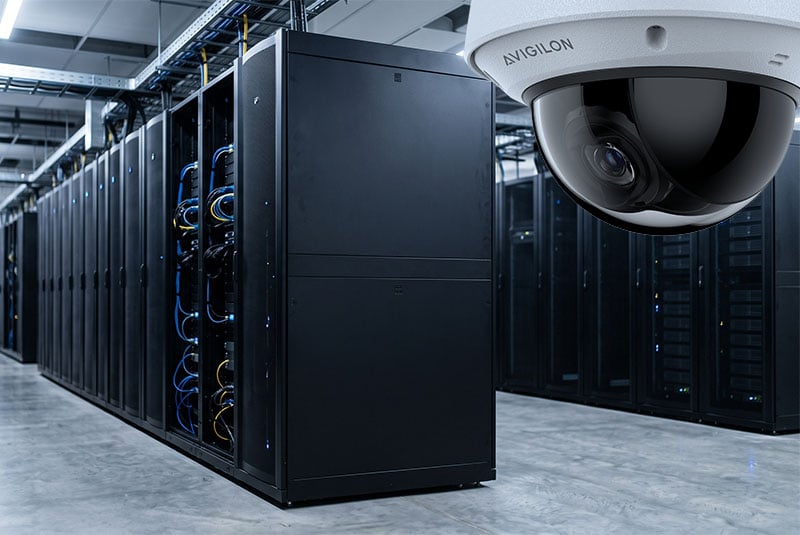





From small on-premises server rooms to facilities spanning millions of square feet, global reliance on data centers makes data center design and architecture critically important to keep businesses operating.
Websites, e-commerce, cloud platforms, video streaming, email, AI and other essential digital services depend on reliable data center infrastructure.
Key takeaways
- Design dictates system reliability: Effective facility architecture safeguards continuous business operations and prevents outages costing over $1 million per incident.
- Security safeguards against data loss: Layered protection — combining perimeter barriers, biometric access, AI video surveillance and smart sensors — protects core assets.
- Compliance prevents heavy penalties: Aligning with GDPR, SOC 2 and ISO/IEC 27001 avoids severe fines, audit failures and legal liabilities.
- Six key elements drive resilience: Preventing catastrophic outages demands a unified design strategy across physical security, architecture, power, thermal management, scalability and legal compliance.
The number one priority for both enterprise and colocation data centers is to reliably keep large amounts of servers running with zero downtime.The consequences of poor design can be devastating.
The per incident cost of a data breach has reached an all-time high. Server outages can cost over $1 million in lost revenue, reduced productivity, recovery expenses and long-term brand damage.
As one of the largest financial and operational investments for a business, mitigating data loss risks depends directly on effective data center design.
This step-by-step guide will teach you what data center design is, how to build a data center, common mistakes to avoid in planning and key considerations in data center architecture.
What is data center design?
Data center design is the strategic planning, construction, and spatial layout of facilities that house the infrastructure used to store, process, and transmit high-value digital assets and critical business systems.
Optimal data center design relies on maintaining proper temperatures, providing continuous power and protecting data. Overlooking any single component directly compromises the others.
Efficient data center design relies on two primary components: IT infrastructure, encompassing servers, storage and network gear and facility support, comprising power, cooling and security systems.
Designing these primary systems involves six essential design elements: security, data center architecture, power and networking infrastructure, cooling systems, scalability and compliance.
Key data center design components
- Security: Research shows growing global concern over personal data access. As of 2026, 144 countries have enacted data privacy laws with strict enforcement. Companies that violate personal data privacy laws may face monetary fines, operational sanctions or criminal penalties. Data center access control systems authorize and monitor facility access. Biometric readers, keycard door readers, wireless locks, video surveillance systems and smart sensors verify identity to grant or deny entry.
- Data center architecture: After defining business needs, allocating budget, site selection and conceptual planning, data center architecture is a critical beginning step in data center design. Data center architecture maps out facility equipment layout, including rack placement, cabling, network topology, generators, mechanical and electrical rooms, cooling units, and fire detection and suppression systems, all while balancing security, energy efficiency and future growth.
- Power infrastructure: Large data centers require massive amounts of electricity to run every facet of their operations. Consequently, facility designs must outline power delivery, backup generators, uninterruptible power supply systems, power distribution units and redundancy models, such as N+1 or 2N, to ensure uninterrupted service.
- Networking infrastructure: Simply put, these are the routers and switches that store and process data.They connect data center servers and storage to end users.
- Cooling units: Nearly all electricity consumed by data center rack servers converts into heat. The American Society of Heating, Refrigerating and Air-Conditioning Engineers recommends maintaining temperatures between 64 and 81 degrees Fahrenheit (18 to 27 degrees Celsius). Server racks can overheat in 1 to 2 minutes, risking unrecoverable data loss. To maintain these temperatures, facilities rely on traditional air cooling, liquid cooling or hybrid systems.
- Scalability: As a business grows, server and storage capacity needs increase. Design plans must accommodate space for additional racks, faster network speeds and expanding support systems.
- Compliance: Building a data center involves strict global compliance requirements, including security, privacy, environmental impact and operational redundancy governed by laws such as the Federal Information Security Management Act in the U.S. and the General Data Protection Regulation in the EU. Specialized construction firms can help guide facility design to meet these location-dependent legal standards.
Protect your data center with modern security
Prevent unauthorized access, avoid unplanned downtime and maintain compliance with a single connected security system.
- Centralize security communications
- Deliver real-time threat intelligence
- Accelerate emergency threat response

Why is it important?
Data protection and security
Data privacy laws vary widely across the globe. For example, data centers handling European citizens' information must adhere to the European Union's General Data Protection Regulation,, considered one of the strictest privacy frameworks in the world.
With more countries enacting laws similar to the GDPR, security must be a top priority in data center design. Regulations govern perimeter security, multifactor authentication and visitor logging.
Failing to protect stored customer data carries significant legal and operational fallout. In the early 2010s, a major U.S. retailer experienced a staggering drop in profit after a data breach, taking over a year to regain its market share.
With data breach costs increasing alongside the sophistication of cyberattacks, it is projected that the physical security asset industry will be valued at nearly $55 billion by 2032. Controlling data access and managing data center security must be top priorities.
Protecting a data center is two-fold: the physical security and the security of the data housed in the data center. On-premesis and cloud solutions like access control units and CCTV systems secure the perimeter to prevent unauthorized entry. Meanwhile, smart sensors monitor temperature, air quality and sounds like gun shots or warning words that trigger alerts to security teams.
Environmental impact
Sustainability planning plays a vital role in balancing resource use. Proactively considering environmental impact during planning helps manage operational costs, ensures regulatory compliance and alignment with community priorities.
Incorporating sustainable water usage methods and improving power usage effectiveness eases the burden on local natural resources and reduces environmental impact. Organizations can act as environmental stewards by developing on-site renewable power sources, such as solar and wind, and adopting closed-loop liquid cooling, direct-to-chip liquid cooling or air-cooled chillers to eliminate freshwater reliance.
How to build a data center
As one of the most modern mission-critical infrastructure projects in the world, data centers are also among the most complex to build, requiring precise coordination to ensure tight security, energy efficiency, optimal performance and high resilience with zero downtime. Data center planning, design and construction is a multiyear, multistep effort requiring expertise in structural engineering, networking, power, mechanical systems and geographic site selection.
1. Architecture and structural engineering
Structural components of data center design include a hardened exterior built to withstand high winds, earthquakes and explosive blasts. Floors and roofing systems must meet strict load-bearing standards, and designs must accommodate future expansion to support additional server racks and equipment.
2. Networking infrastructure
To maintain high network reliability and accommodate expansion, data center architecture relies on structured cabling that complies with global standards such as ANSI/TIA-942, TIA-606-C and ISO/IEC 11801. Unorganized cabling can disrupt airflow, impede maintenance access and restrict future growth.
3. Power and mechanical infrastructure
An uninterruptible power supply system is essential to keeping a data center online 24 hours a day, seven days a week. Facility designs incorporate primary power feeds, on-site transformers and redundant power sources, such as battery backups and emergency generators.
Cooling systems consume nearly half of a data center’s power. Determining the most effective cooling method depends on rack density, local utility availability and total operational costs.
4. Location
Selecting an optimal location for a new data center depends on access to power and fiber, local climate and regional laws and zoning regulations. Balancing risk against these factors helps narrow potential construction sites.
Common mistakes in data center design & planning
Besides financial losses, poor data center design and planning can lead to outages, increased cost in operations and vulnerability to security breaches.
Defining project scope before initial development begins helps organizations avoid five common data center design and planning mistakes.
- Overbuilding/underbuilding: Failing to project growth accurately leads to either overbuilding or severe operational bottlenecks. Planners can avoid these pitfalls by installing proper overhead cable pathways, reserving floor space for additional racks and adopting a modular, phased development approach.
- Inadequate cooling: Relying solely on traditional air cooling creates severe overheating risks. Facilities should incorporate liquid or immersion cooling systems to safely support high-density hardware.
- Flawed site selection: Choosing a site based solely on cheap land can prove detrimental. Planning must evaluate floodplains, power grid access, transportation logistics and supply chain availability.
- Overlooking lifetime accessibility and maintenance: Overlooking long-term accessibility creates cramped pathways that present occupational hazards, restrict airflow and hinder technician mobility during routine repairs. Design teams can eliminate these bottlenecks by enforcing strict spatial standards during early architectural planning.
- Cutting corners on security:Incorporating a multifaceted physical security system prevents severe fallout, including lost certifications, broken client trust, breach of contract penalties, data breaches and operational outages. A comprehensive security system can prevent data center breaches, detect real-time threats and enable rapid response.
The Motorola Solutions advantage
Without reliable, continuous power, all other data center design elements are at risk of failure. Securing the facility is equally vital to ensure physical threats do not compromise that power supply. Neglecting security can lead to catastrophic consequences, dismantling years of planning and costing millions of dollars in damages.
Motorola Solutions provides a purpose-built safety and security technology ecosystem designed to protect mission-critical data center infrastructure. The integrated platform pairs cloud-based access control with AI-powered video solutions to monitor perimeters, prevent unauthorized entry and detect internal threats in real time. Automated alerts instantly notify command centers during access violations, enabling security teams to review audit logs and respond with certainty. By unifying access management, video analytics and enterprise software, Motorola Solutions helps operators safeguard uninterrupted power, maintain regulatory compliance and prevent costly operational downtime.
Conclusion: The broader impact of secure data centers
Nearly every modern interaction — from enterprise communications and consumer streaming to life-saving operations across health care, government and law enforcement — relies on data centers. Confidence in data center security drives operational resilience, safeguards enterprise value and empowers the safer, thriving communities that depend on mission-critical digital infrastructure.
Data center design FAQs
Get quick answers to the most common questions about data center design, including pricing, compliance and project timelines.