

With downtime costing mid- to large-sized enterprise companies $1 to $5 million an hour — and for smaller businesses, $10,000 an hour — and 90% of small businesses failing after an disaster, even the smallest disruption can be consequential.
Avoiding such catastrophic failures begins by building an enterprise crisis management plan.
What is a crisis?
A crisis in business is any unanticipated event that disrupts regular business operations. There is no business, regardless of its size, that is immune to experiencing a crisis.
According to PwC’s Global Crisis and Resilience Survey, 91% of enterprise businesses experienced a major disruptive crisis in just a two-year window. McKinsey research similarly indicates that large organizations face a significant operational crisis every 3.7 years on average.
With these statistics in mind, it’s inevitable that your business will experience some level of crisis throughout its lifetime. To protect people and property, minimize impact and build resiliency, businesses of all sizes need to start viewing crisis management as a core operational function.
What is crisis management?
Crisis management is an organization's strategy for responding to and recovering from unexpected, high-impact events to protect stakeholders and ensure business continuity.
The International Organization for Standardization defines a crisis as an “abnormal or extraordinary event or situation that threatens an organization or community and requires a strategic, adaptive and timely response in order to preserve its viability and integrity.”
Effective crisis management protects employees, minimizes financial loss, ensures business continuity, preserves brand trust and maintains regulatory compliance. Studies show that companies with regularly tested operational resilience playbooks bounce back faster and retain higher stock value one year post-crisis.
While disaster recovery protocols cannot prevent a crisis, they help control panic, reassure stakeholders — including employees, vendors and customers — and accelerate overall recovery.
Stages of crisis management
Building true organizational resilience goes far beyond maintaining a basic emergency response plan. Proactive preparedness must become embedded in a company’s culture. To protect your organization, follow this step-by-step crisis management framework to guide your team’s response during a disruption.
Prevention
Though impossible to prevent every threat, especially external threats, a thorough risk assessment will help identify vulnerabilities and early warning signals.
A risk assessment identifies potential crisis scenarios, evaluates their likelihood and measures their potential impact. This process helps organizations prioritize threats and allocate resources where they are needed most.
After completing a risk assessment, implementing solutions like access control systems, compliance audits, cybersecurity protocols and crisis management software helps mitigate major operational threats across your industry and location.
Crisis management software
Empower your team to plan, manage, and bounce back faster from operational disruptions.
- Real-time incident tracking dashboards
- Automated SMS & email mass alerts
- Digitized emergency playbooks

Who in the company should be involved in a risk assessment?
A cost-effective approach to risk assessment starts by assembling a cross-functional team of leaders from core departments like operations, IT, HR and facilities. Alternatively, hiring an external risk management firm to conduct a risk audit helps eliminate internal blind spots and bias. For highly regulated industries requiring validated compliance, these external audits can be well worth the investment.
Preparedness
The preparedness phase focuses on planning how an organization will respond to a disruption. Assembling a cross-functional crisis response team is the critical first step.
This team should include leaders from core business units: human resources, IT, communications, product, legal, accounting, operations and security, alongside executives and board members. Beyond spearheading response activities within their departments, these leaders build organizational buy-in and reinforce the importance of crisis readiness.
During preparedness, the team builds detailed response plans, develops threat scenarios, conducts crisis drills and secures necessary response resources. Establishing clear internal and external communication protocols is a vital part of this process.
For organizations building crisis plans in-house, risk management software offers built-in templates, real-time dashboards and automated checklists to streamline execution.
Response
When a crisis occurs, the response phase puts the preparedness plan into action. After ensuring employee safety, leaders must immediately mobilize the crisis management team, establish a central command center and monitor real-time data to assess the event’s severity and duration.
A loss of public trust can devastate a company's long-term viability, making clear communication a critical part of disaster response. What an organization says — and how quickly it responds — directly impacts brand reputation. Establishing strong, transparent leadership helps control the narrative.
Under modern crisis communication standards, the traditionally observed "golden hour" response window has condensed: stakeholders now expect official statements to be prepared, approved and distributed to their respective audiences within 15 to 30 minutes.
Recovery
Once an active threat subsides, the recovery phase begins as the organization begins to resume normal operations. During recovery, the response team assesses damage, prepares post-incident reports and continues issuing status updates to stakeholders.
Detailed analysis and documentation gathered during recovery serve as the critical foundation for the final phase of crisis management: post-crisis evaluation and learning.
Review
Once immediate recovery is complete, the crisis management team should conduct an after-action review. This evaluation analyzes what happened and assesses the speed and effectiveness of the organization’s response.
A comprehensive post-crisis review should include:
- Timeline of events: Documenting key milestones and decision points as the crisis unfolded
- Playbook audit: Comparing actual response actions against established playbooks to identify operational gaps
- Loss evaluation: Calculating total financial, operational, physical and reputational damage
- Response speed metrics: Measuring how quickly leadership mobilized, activated the command center and issued statements
- Corrective actions: Implementing immediate operational fixes and patching revealed vulnerabilities
- Plan updates: Refining playbooks, training programs and communication templates based on lessons learned
The after-action review is not the end of crisis response, but the foundation of long-term business resilience. Its goal is not to assign blame, but to strengthen future readiness by asking one fundamental question: "What will we do better next time?"
How to create a crisis management plan
Developing a comprehensive emergency response plan ensures your organization is prepared for any operational disruption. Use these key steps to establish clear roles, build response protocols and maintain long-term resilience:
- Conduct risk assessments
- Identify and prioritize potential risks based on probability and impact
- Rank the risks in distinct levels
- Form a crisis management team
- Establish a chain of command in the team
- Document response actions
- Create a sequence of steps to take during response including specific timelines
- Identify warning signs and what will trigger an alert
- Assign response tasks to members of the team
- Strategize internal and external communications with timelines, including appointing a spokesperson and preparing statements
- Train and test
- Revisit the plan quarterly to update as necessary
Testing your plan
Rigorous training and testing are imperative to expose operational gaps and refine response protocols long before a real crisis occurs. Regular testing acts as a diagnostic audit for your company to help uncover critical failure points during crisis response such as lagging response times, role confusion and communication gaps.
Testing helps instill confidence in roles and executing responsibilities, improve response time, reduce panic-induced decision-making and increase compliance.
During your initial drill, evaluate whether your response actions are truly measurable. If they’re not, update your action plan to establish clear metrics for tracking response execution and operational impact.
When measuring drill performance, ask the team these three core questions:
- Did you have to improvise at any point?
- Was the plan flexible enough that you could adapt as the situation evolved?
- Where and what were your biggest roadblocks?
Our partnership with Preppr
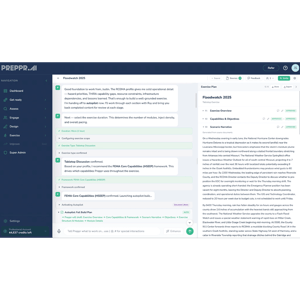
Preppr’s AI engine uses your crisis plans to build multi-branch scenarios and test what-if conditions in minutes.
- Turn crisis plans into test scenarios
- Run live drills and track decisions
- Update plans and retest
What are the best methods to test a business crisis management plan?
Organizations can test a business crisis management plan using four primary methods: tabletop exercises, functional drills, full-scale simulations and unannounced drills. Testing ensures leadership roles are clear, response playbooks are accurate and operational response times meet performance benchmarks before a real crisis occurs.
- Tabletop exercises: During a tabletop exercise, the crisis management team walks step by step through a hypothetical scenario using their response playbooks. Led by a facilitator, these discussion-based workshops measure decision-making speed, role clarity and internal communication flows. Because they are nondisruptive to daily operations, tabletop exercises can be conducted frequently.
- Functional drills: Functional drills are real-time, task-specific tests focused on evaluating specific operational capabilities.Teams actively execute specific responsibilities under timed conditions, such as restoring backup databases, issuing statements to the media or initiating evacuation procedures.
- Full-scale simulations: A full-scale simulation is a comprehensive exercise that replicates a live crisis scenario in real time. These hyper-realistic drills stress-test the entire organization and often require coordination with external emergency responders, law enforcement and key vendors.
- Unannounced drills: Unannounced drills test team readiness without prior warning. By triggering a surprise notification or command center activation, businesses evaluate off-hours responsiveness and how well leaders perform under unexpected pressure.
Creating a crisis management team
A crisis management team is a core group of decision-makers who assess business risks, write response playbooks and hold the authority to execute emergency plans. While single-location businesses need only one core team, enterprise organizations with multiple sites should establish secondary local response teams.
When deciding who should be on the team, membership should be selected based on leadership ability, subject matter expertise, rapid analytical skills, solid decision-making and composure under pressure. Core members typically include department heads and senior leaders across finance, operations, product, sales, marketing, communications, human resources, legal and IT.
Before a crisis, team members will determine and procure resources, train department staff and help with writing playbooks. During a crisis, they detect warning signs, assess impact, execute response plans, arrange emergency services and communicate continuously. After the crisis ends, the team evaluates performance, revises playbooks and replenishes resources to build future resilience.
Crisis management team structure
- Crisis manager: Serves as the overall lead. Rarely the company president or CEO, the crisis manager sets priorities, directs activities and makes final decisions.
- Communications: Manages messaging and handles public relations.
- Legal: Ensures regulatory compliance and limits liability.
- Operations and facilities: Secures buildings, equipment and supply chain.
- IT: Safeguards critical infrastructure by managing core systems, network security and data backups.
- Human resources: Coordinates employee safety, directs internal communications, conducts family notifications and provides post-crisis support programs.
Every role must feature a fully documented list of duties alongside a designated backup lead in case the primary lead is unreachable.
Stronger crisis management today for stronger recovery tomorrow
PwC’s Global Crisis and Resilience Survey found that 84% of business leaders report resilience is a top priority; however, only 26% maintain a fully functional crisis management plan.
With extensive research proving that resilient companies recover faster and outperform their competitors following a disruption, proactive crisis planning is an operational imperative.
As new operational, digital and reputational threats emerge, a structured operational resilience strategy protects company assets, maintains business continuity, accelerates post-crisis prosperity and, most importantly, keeps employees safe.
Don’t wait for a disruption to test your operational limits. Begin building a proactive enterprise crisis management framework today.