

Streamlined communications, great customer or client outputs and positive working environments are essential parts of a company’s overall success. But long-term success is only possible if operations are maintained even as employees leave, management changes or the unexpected happens. A truly sustainable organization is one that creates emergency preparedness and response strategies to protect its operations, customers and employees from unexpected events.
The best way to secure the continuity of normal operations is to implement a continuity plan that covers a variety of scenarios, including floods, fires, active shooters, workplace violence and cyberattacks. With the right continuity plans in place, you can build a more resilient organization and workforce. But when we talk about business continuity and business resilience, there are a few key differences to consider.
What is business continuity?
A business continuity plan (BCP) is a structured system that helps companies anticipate, withstand and recover from potential threats. Organizations need BCPs to ensure personnel and assets can bounce back and restore normal operations following emergency events such as severe weather and natural disasters, active assailants, mental health crises and threats. These plans aim to keep organizations capable of achieving their objectives, such as supplying and delivering goods and services, after unexpected disasters or emergencies occur.
Larger organizations typically have a manager or team designated to perform business continuity management (BCM) functions — specifically, the development and maintenance of BCM protocols, including BCPs. However, for smaller organizations, they generally fall under the responsibility of HR.
The benefits of utilizing business continuity plans
Developing a business continuity plan is an essential part of ensuring organizations can continue to run smoothly while protecting their employees.
With a BCP, corporations are much better equipped to:
- Sustain continuous operations
- Return to regular operations faster after disruption
- Protect against financial losses
- Stay in compliance with legal requirements
- Ensure the safety and well-being of all staff and personnel
- Be prepared with contingencies for worst-case scenarios
- Give everyone a clear picture of what to do in an event
These plans can enhance a company’s overall resilience and help employees and teams adapt to developing circumstances.
What to include in a business continuity plan
When developing a BCP, organizations should identify potential risks, then analyze how they may impact operations and compromise safety. All procedures should be tested to ensure they work and confirm that all standards are up-to-date.
Whether your organization currently has a BCP in need of an update or you’re looking to develop a new one, consider following these steps:
- Business impact analysis (BIA): Organizations should identify functions and resources that are time-sensitive and essential for operations. Performing an analysis means that companies can prioritize the processes that have the highest impact on them, such as recovery, organization and training.
- Training plan activation strategies: Each employee in the company should be aware of BCPs and how they should be executed, even if no action is required of them. This includes training sessions for key stakeholders and emergency management staff.
- Regular reevaluation: BCPs need to be assessed and tested often. As times and laws change, BCPs should also evolve with an organization’s specific needs.
By implementing these strategies, your BCP is more likely to work effectively and boost your enterprise resilience, and can help your teams more easily adapt to various situations as they happen.
What is business resilience?
Business resilience is the general term for an organization’s ability to adapt to unforeseen circumstances while remaining capable of consistently achieving its objectives, thereby continuing to survive.
Business resilience is often a key objective of an organization’s overarching strategy, which is embedded into both its strategic framework and company culture. A successful strategy that’s been developed with business resilience in mind should include provisions for business continuity planning, crisis management, risk management, disaster recovery and incident response.
What it takes to successfully foster business resilience
Business resilience isn’t secured overnight and cannot be accomplished without the support of key stakeholders.
Organizational leaders must consider possible disruptions and how their companies will respond to them. When leaders are prepared and have developed plans of action to respond effectively, crisis managers have clear directions for how to protect the safety and well-being of their employees.
When organizations value the protection of all employees, they can feel at ease about their safety, especially in a world of uncertainty and inevitable crises. But for this to work, leadership must foster a culture of safety through clear metrics, employee training and practicing those values themselves.
The benefits of business resilience
Organizations that operate with business resilience as a core principle can reap a number of notable benefits like:
- Adapting faster to dynamic circumstances
- Supporting long-term growth and financial stability
- Protecting and encouraging employees
- Fostering an environment of growth
Without resiliency, organizations would find it incredibly difficult to move forward successfully after emergencies.
Boost your business continuity
Strengthen your incident preparedness and enterprise resilience with advanced, secure business continuity software.
-
Leave analog paper plans in the past
- Map critical operational dependencies
- Plan, document and test event scenarios
Why organizations need both business continuity and business resilience to thrive
While an organization can gain operational and strategic advantages from implementing either a business continuity or business resilience program, pursuing both yields the best chance for continued success.
While business continuity empowers organizations to prepare and codify protocols by which to operate during immediate disruptions, such as severe weather, natural disasters, active assailants, mental health crises and system failures, the broader application of business resiliency guides organizations as they form long-term strategic plans that enable continuous operations no matter what comes their way.
Implement a business continuity plan
Long-term resilience is next to impossible without an established BCP. Even if an organization cannot predict emergencies before they happen — and no organization can — it cannot achieve optimal preparedness unless they are prepared to invest the necessary time and effort.
Involve all key stakeholders and employees
BCPs cannot deliver dependable business resilience unless every affected individual at an organization is involved in its implementation.
To drive more across-the-board engagement, emergency managers should offer opportunities for regular input and feedback. Employees who feel empowered to ask questions and share ideas feel more invested in their own safety. Plus, strong feedback can help encourage safer behavior and reduce health and safety risks.
Monitor for threats
To build dependable business resilience, it’s vital to know which kinds of threats your organization is likely to face. Key stakeholders can not only advise on your organization’s threat landscape, but involving them in your BCM program will help them to better understand their business continuity responsibilities.
Threat monitoring can help identify potential situations or track developing issues that can impact your operations. Increasing awareness enables faster response times when trouble strikes, which ultimately helps to mitigate losses and keep everyone in the loop.
Driving stronger business continuity and business resilience with collaborative tools
Business continuity plans are essential to maintaining resilient operations — but most importantly, they keep employees safe. Before an emergency occurs, rigorously train your team members on their roles in your BCP and promote effective communication to ensure that everyone knows what to do.
Open and accessible lines of communication are also crucial to ensuring that everyone stays safe when disaster strikes. To guarantee that your organization will have access to secure communication lines during an emergency, consider acquiring an emergency communication solution that can remain functional no matter which type of situation is at hand.
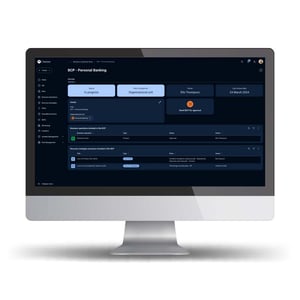
One of the more futureproof ways your organization can better prepare for inevitable adverse events or other emergency scenarios is with business continuity software. This solution lets you securely document dynamic, digital business continuity plans to replace paper plans that are harder to update and easily lost. Business continuity software also includes intuitive workspaces where leadership and other stakeholders can freely develop and codify long-term strategies built on business resilience.
Additionally, business continuity software is just one solution among a larger enterprise resilience software suite that can deliver even more benefits in mission-critical areas like security management, crisis management and security operations center (SOC) automation.
By incorporating effective business continuity frameworks like BCPs and principles of business resilience, your organization can rest easy and refocus on day-to-day operations with the comfort and security that comes with more complete incident preparedness and stronger enterprise resilience.
To find out how easily you can build a more resilient organization, contact us today.