
Trusted by 100,000+ organizations globally








Preventing unauthorized access to facilities is critically important for the safety and security for all businesses and organizations. Becoming more common across many industries, biometric access control is replacing keycards, badges, fobs and passwords to authorize entry into buildings and restricted areas.
As a multibillion-dollar industry, biometrics is the fastest-growing sector in security hardware. Biometric readers are a reliable way to grant only authorized users entry to restricted and secured areas.
Security and operational losses cost companies billions of dollars a year. Switching to a biometric door access control system helps mitigate high-cost risks related to access.
This guide covers what biometric access control is, how it works, common types, key benefits and how to choose the right system for an organization.
What is biometric access control?
Biometric access control systems use sensors to read an individual’s unique physical traits, such as fingerprints or retina scans, to authenticate someone’s identity giving them access into a building, room or network.
A person’s physical characteristics, such as fingerprints and the patterns of the blood vessels in the retina are unique, making biometric controls a highly accurate and more secure way to verify authorized users.
Because of its high level of accuracy, these systems are used in areas where security is highly sensitive, such as government offices, server rooms, research and development facilities, laboratories and rooms where personnel and financial records are stored.
In lower-security areas such as main entrances, executive offices and shared facilities like restrooms, break rooms and conference rooms, biometric systems are fast, convenient and require less oversight from security teams.
Businesses replacing traditional methods of entry with biometric technology find it not only convenient, but also valuable across the organization. It increases security, lowers theft risks, reduces IT and administrative costs, aids regulatory compliance and accurately logs activity.
How biometric entry systems work
Biometric access control verifies identity using unique physical traits. A typical system includes a biometric reader, an access control panel, management software and door locks.
These core components communicate through a simple, secure process. When users scan their fingers or eyes at the reader, the device transmits data over a secure line to the access control panel. Once credentials are validated, the system signals the door to unlock. Simultaneously, a door sensor logs when the door opens and closes, recording every entry in the activity log.
The biometric reader itself is wall- or door-mounted hardware housing the scanner that captures physical traits.
Usually installed in a server room or IT closet, the access control panel serves as the main hub. It receives data from the scanner, interprets the credentials and triggers the lock.
Software automatically encrypts and stores user data, while giving security admins an easy way to enroll users and manage the system.
The system also requires electrified locking hardware to unlock the door.
Before a biometric system authenticates credentials and unlocks doors, users must enroll.
The system registers an individual by reading a unique biological trait, such as fingerprint grooves or retina patterns, using a highly sophisticated sensor built into a biometric reader. The system then encrypts the trait data into a mathematical code to create a template.
The template is saved in a secure database that matches each user's profile and entry permissions.
During authentication at a door or entry point, the system scans an eye, finger or other physical feature. It instantly creates a temporary template of the physical characteristic and compares it to saved encrypted templates.
In less than three seconds, a matching template triggers an electronic door lock to allow access.
Common types of biometric access control systems
Fingerprint readers and retina scanners lead the biometric access control market. Government and defense entities adopt the security technology at the highest rate, followed closely by the enterprise and real estate sectors.
What are fingerprint readers?
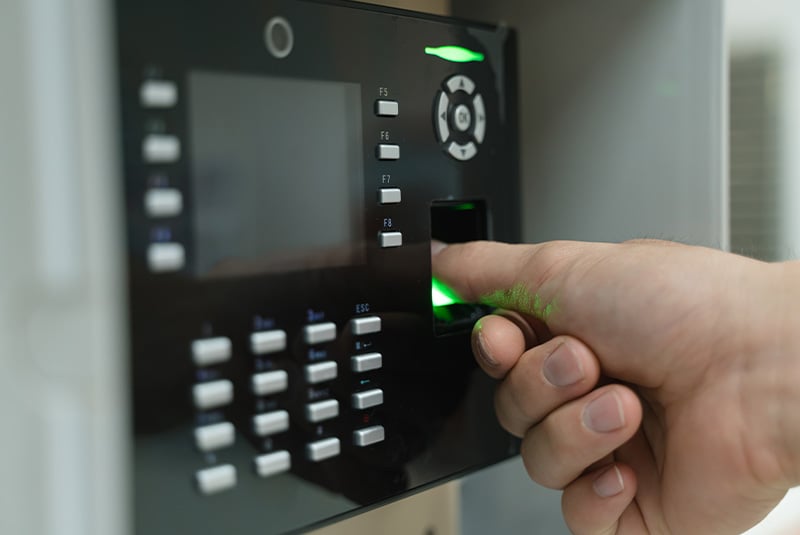
Fingerprints consist of microscopic ridges and valleys. These are the raised and lowered patterns on fingertips. Fingerprint ridges curve, stop and branch off. The points where they change are called minutiae. When someone places a finger on a reader, those ridges touch the sensor glass. Fingerprint door access systems capture these unique patterns to verify identity.
Software then maps the exact coordinates of 30 to 80 unique minutiae points. The system converts that data into an encrypted binary code to create a template. The fingerprint access control system verifies the print by searching saved templates for a match. An electronic signal then unlocks the door and logs the entry.
There are three different types of fingerprint sensors: optical, capacitive and ultrasonic.
Like digital cameras, optical sensors use light and a miniature camera to capture a fingerprint, creating a high-resolution 2D image of its ridges and valleys. Best suited for high-volume areas, optical access control units are durable and cost-effective. However, they are sensitive to wet, greasy or dry fingers and are vulnerable to presentation attacks, or spoofing.
Capacitive sensors use small electrical circuits that measure charge differences between fingerprint ridges and valleys. Because they rely on electrical currents, capacitive readers are difficult to spoof. They are ideal for high-security indoor access points, but they are more expensive, less durable and sensitive to weather.
By using high-frequency sound waves to construct a 3D map of a fingerprint, ultrasonic scanners offer high reliability in harsh conditions and are extremely difficult to spoof. Although they are a more expensive option, ultrasonic sensors are ideal for outdoor access points in high-security environments, such as government, defense, industrial and construction facilities.
What are retina scan door locks?
As the biometric access control method with the lowest False Acceptance Rate, retina scanners use infrared light to scan the network of blood vessels in the retina, located in the back of the eye.
Like fingerprint readers, retina scanners create a digital template that biometric software matches against a user's profile to authenticate entry. When a match occurs, the system unlocks the door.
Nearly impossible to fake, retina scan locks are most often used in highly-classified and high-level security applications.
Key benefits of biometric entry systems
Biometric access control systems make user authentication easier and more secure, preventing unauthorized entry.
- Increases security: Biometric entry systems rely on unique physical features that cannot be shared or swapped, significantly reducing unauthorized access. Implementing these systems eliminates buddy punching and the theft of protected information such as PIN codes. Restricted and high-security areas are better protected because of the accuracy of biometric readers.
- Supports multifactor authentication: While biometric readers provide strong standalone security, they can also be combined with traditional credentials to create multifactor authentication (MFA). Multifactor authentication requires users to present two or more different forms of proof before a door unlocks.
- Lowers administrative and operational costs: Biometric credentialing saves security, IT, human resources and administrative teams significant time and money by eliminating the need to replace badges, reset PINs and physically monitor access points.
- Accountability and compliance: Real-time monitoring allows biometric controls to simplify timekeeping by automatically logging entries and exits, creating an indisputable audit trail. Precise timekeeping ensures legal compliance while eliminating time theft. These systems also support multifactor authentication.
- Seamless integration with existing systems: Biometric entry systems integrate directly with existing business software. Instead of managing access in a silo, biometric platforms connect via APIs to payroll and visitor management systems.
New employee profiles automatically sync to the access control system, saving administrative time and reducing manual data entry errors. When employees resign or leave an organization, updating their status in the human resources portal instantly revokes access across every biometric door lock.
- Scalability: Biometric access control systems are designed to scale with a business. Users need to register only once. Bandwidth and data storage are minimal concerns, as encrypted templates require little space. Systems integrate with existing application programming interfaces, allowing security teams to manage access points through the cloud.
- Adoption acceptance: To meet strict data privacy laws, biometric authentication technology converts physical scans into encrypted mathematical codes rather than saving actual photos or fingerprints. Because these codes cannot be reverse-engineered into readable images, user privacy remains protected even if a server breach occurs. To maintain compliance, organizations should use strong encryption, establish clear employee consent policies and automatically delete user data when an employee leaves.
Because most people already use biometrics to unlock smartphones daily, workplace adoption requires virtually no training.
Choosing the right biometric system
How to choose the right biometric access control system? When deciding which system is best, consider these four important factors.
1. Level of security
Fingerprint access control is the most popular biometric due to its lower cost, accuracy, durability and familiarity of the technology. Fingerprint readers are best suited for high-volume, lower-risk areas.
Retina scan locks offer higher security with a significantly lower false-positive authentication rate than fingerprint readers. While some users find retina scans intrusive, the technology is unmatched for securing classified information and critical infrastructure.
2. Budget
Although initial installation costs can be high, biometric entry systems can reduce overall security expenses over time. Key factors to consider include the number of scanners required, how many doors need compatible locks, the location of access points and expected traffic.
3. Technology infrastructure
Implementing biometric access control requires evaluating hardware, software, bandwidth and network speed. Organizations must decide whether to host the system on-premises or in the cloud, while accounting for user volume and peak traffic times.
Utilizing an existing access control system can lower initial expenses. Otherwise, the labor and cost of wiring must be factored into the budget. Organizations should also account for ongoing maintenance and software updates when calculating total system costs.
After defining the scope of implementing a biometric door lock system, narrow down the different types of systems based on locations in the building, MFA support, speed, onboard processing and local template storage and template and log activity capabilities and how many readers the access control panel can support.
Total cost goes beyond the upfront price of readers and locks. Organizations should budget for software licenses, routine maintenance, power setups and network capacity. Systems that verify scans on a central server require fast network connections to prevent long lines at the door. Conversely, readers that process and store user data locally use minimal network bandwidth, helping keep infrastructure upgrade costs low.
How to set up a biometric access control system
Biometric access control systems are composed of both hardware and software. There is a central access control panel, readers and locks. The software integrates with the existing network and registers and verifies users.
Security experts recommend consulting with biometric vendors to design and install these systems. Their professional expertise will help ensure a comprehensive plan and expert installation.
 Assess security and business needs
Map out required readers and door locks
Schedule professional installation of hardware and software.
Install and configure software. Register users.
Define access permissions
Sync and test the system
Assess security and business needs
Map out required readers and door locks
Schedule professional installation of hardware and software.
Install and configure software. Register users.
Define access permissions
Sync and test the system
Alternatives to biometric access
If a biometric control access system is not the right fit due to scale or budget, there are alternatives. Mobile access, proximity readers, smart keypads and video intercom systems are commonly used in office buildings, apartment complexes and hotels where security is just as important but risks are lower.
Mobile access control, like biometric access control, eliminates the need for keycards, badges or fobs. Proximity readers use Wave to Unlock technology through authorized users mobile phones, smartwatches, tablets or apps. Mobile readers can also use QR codes which are commonly used for giving temporary access.
Proximity readers also verify users through smart and RFID cards, badges and secure digital credentials for touchless access.
Smart keypads authorize entry through PIN code access.
Some systems combine mobile access control with intercoms, high-resolution video or PIN access for added security.
Conclusion
Protecting your physical spaces and sensitive data requires moving beyond easily lost, stolen or shared credentials. While traditional keycards and badges carry high recurring replacement costs, biometric access control provides a permanent, non-transferable physical security solution. By upgrading to fingerprint or retina access control, organizations protect high-value assets, streamline administrative workflows and eliminate the costly security gaps of legacy locks.
Whether securing a single server room or a multi-building enterprise campus, implementing a biometric entry system helps ensure your facilities remain secure, compliant and ready for future growth.
Biometric access control FAQs
Find answers on biometric access control costs, system hacking risks, reader lifespan and integration into existing systems.