
Trusted by 100,000+ organizations globally








Ensuring the safety of apartment building residents while maintaining efficient property oversight is a major concern for any property manager or landlord. Apartment building security cameras play a critical role, as they act as both a deterrent to potential crime and as a tool for daily management.
Landlords can foster a more secure and comfortable environment by integrating advanced camera solutions, prioritizing tenant well-being and protecting the property’s long-term value.
This guide discusses the benefits, types, installation and more of security cameras for apartment buildings. It also covers the several components that work together to create a complete building surveillance system, including cameras, video management systems (VMS) and video infrastructure.
Help secure your apartment
Better protect your apartment building and deliver greater peace of mind to your residents.
-
Crisp, clear images in any condition
-
Automatic AI-powered threat detection
-
A camera for every situation
Benefits of apartment building security cameras
Investing in modern video security for apartment buildings creates value for both management teams and residents by merging active observation with daily operational tools.
For property managers and owners:
- Theft and crime prevention: Visible security cameras discourage crime as it increases the likelihood of a thief being caught. Footage from the cameras can also help to identify the criminals and can serve as evidence against them.
- Quick incident response: Security camera systems can allow for real-time alerts for emergencies, allowing building managers to stop incidents from escalating or even happening.
- Enhanced access oversight: Security cameras can integrate with cloud systems to visually verify identities of visitors and delivery workers and allow access in an easier and safer way.
For residents and tenants:
- Improved safety: Cameras automatically reduce physical security threats in common areas, making residents less prone to theft and crime.
- Peace of mind: Visible cameras build tenant confidence and create a sense of security in their living environment, increasing satisfaction.
- Visitor management: Tenants are able to easily and securely allow guests in, without putting the building at risk.
Building surveillance system components
There are several components that go into creating a complete apartment video security system. While cameras are important, operations are enhanced when they are supported by accompanying hardware and software working together. This integrated solution consists of:
Core Hardware
- Security cameras: Cameras serve as the visual aspect of a security system, sending video feed to monitors and other devices for further analysis and review. They also provide an overall sense of safety and security as natural deterrents to crime.
- Recording and storage device: The footage from the security cameras at apartment complexes needs to be recorded and stored somewhere. For IP cameras, this can be done with a Network Video Recorder (NVR) or for analog systems, a Digital Video Recorder (DVR).
- Monitors and workstations: These are the devices on which live feeds and recordings from the security cameras can be viewed. They can be monitors, tablets, mobile devices and more.
- PoE cabling and infrastructure: Most cameras connect to modern apartment security camera systems using Power over Ethernet (PoE) cables. This wiring connects the system and powers the cameras, ensuring a reliable connection.
Software and intelligence
- Video management system: A VMS receives video data from the condo security cameras and gives staff the ability to look back on recorded footage. Cloud-based systems allow staff remote access to the camera data so that they can access it from a remote location at any time.
- AI video analytics: These advanced algorithms can analyze live video feed in real-time to detect and classify objects including people and vehicles. Combined with security cameras, AI video analytics, can identify suspicious activity and send real-time alerts and information to the security team.

View products
IP security cameras
A broad range of intelligent apartment complex security cameras designed to capture high-quality video.
View products
View products
Video management systems
Choose from cloud and on-premise VMS offerings for secure, scalable protection that fits any site or industry.
View products
View products
Video infrastructure
Explore robust NVR systems and versatile Cloud Connectors to support your building surveillance system deployment.
View productsCommon types of apartment security camera solutions
Available in various models and sizes, apartment complex security cameras offer specialized features tailored to distinct safety needs. The most common options for apartment real-time video surveillance include:
Dome cameras
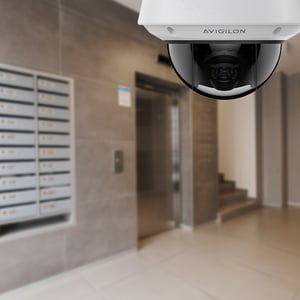
Dome cameras are low-profile security cameras with a wide-angle lens enclosed in a protective casing to prevent tampering. They are ideal for facial detection, object classification and line-crossing and can be surface-mounted to walls or ceilings for both indoor and outdoor use.
Bullet cameras
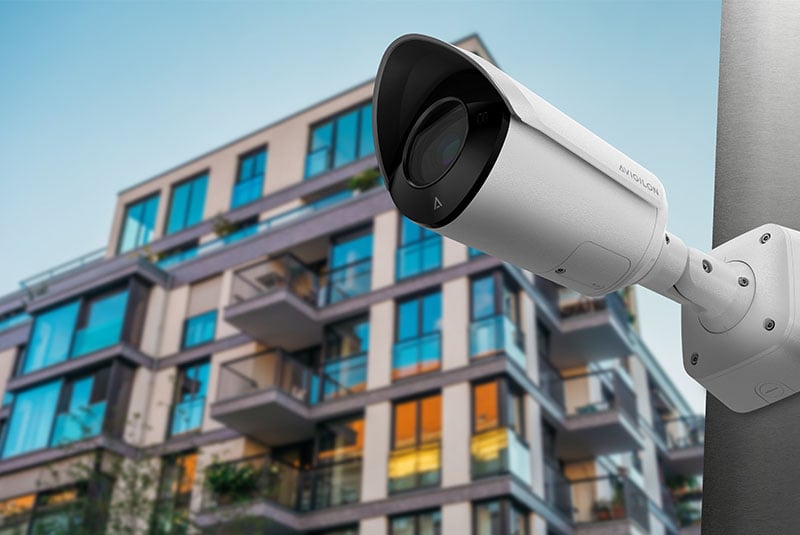
Bullet cameras feature a cylindrical housing for narrow, long-range coverage and provide high visibility. The best bullet security camera systems are used for perimeter protection and LPR capabilities. Installation of these cameras includes adjustable wall/ceiling brackets and can be placed indoors or outdoors.
Panoramic cameras
Panoramic security cameras for condos provide up to 360-degree coverage and are best for crowd tracking and multi-directional motion. They can be mounted flush or on surfaces with weather/dust protection and are great for large and open indoor or outdoor areas.
PTZ cameras
PTZ cameras have a robotic head that can be moved remotely by security teams to see different areas of a location and to zoom in on details, often large outdoor spaces, such as a parking lot or communal garden. They are best mounted with heavy-duty hardware to walls, corners or poles.
LPR cameras
License plate recognition (LPR) cameras use specialized video analytics to scan, detect and classify vehicle license plates in real-time. These cameras help to monitor parking garages and entry gates with the ability to identify high-risk vehicles. They also enable seamless parking access for residents and visitors as they are able to automate entry.
Video intercom
Apartment video intercom systems use built-in cameras to capture photos or video of all individuals entering a building. These systems enhance security and convenience, allowing residents to verify visitors visually before granting them access. They also provide the ability for property managers to go back and review access logs in the case of suspicious activity.
Specialty cameras
For your unique sites and safety challenges, specialty cameras provide flexible solutions. For example, if you prefer discreet monitoring in shared spaces within your apartment building to make residents feel more comfortable, the H5A modular camera offers a compact, unobtrusive design that blends into your environment while maintaining high-quality surveillance.
Comparing the best apartment security cameras


Before choosing the right security cameras for your apartment complex, it is important to assess your building's needs and compare the different options. This comparison table evaluates the primary features of different security camera types to help you identify the best fit for your apartment’s security needs.
| Dome | Bullet | |
|---|---|---|
|
Design |
Discreet, dome-shaped casing |
Cylindrical bullet casing |
|
Range/Field of view |
Wide, short-range coverage |
Narrow, short- and long-range coverage |
|
Use cases |
Discreet observation of indoor spaces |
Visible coverage of expansive outdoor spaces |
|
AI analytics |
Ideal for facial detection, object classification and line-crossing |
Long-distance perimeter detection and license plate recognition |
|
Installation |
Fixed directly to the surface of walls or ceilings |
Fixed to an adjustable wall or ceiling-mounted bracket |
|
Environment |
Indoor and outdoor. Casings offer impact/vandalism protection. |
Indoor and outdoor. Some casings offer impact/vandalism protection. |
|
Two-way audio |
Built-in microphone/speaker or input/output audio ports |
Integrated mic/speaker or external audio connections |
|
Cost |
Lower cost |
Lower cost |
| Panoramic | PTZ | |
|---|---|---|
|
Design |
Multi-lens dome or bar housing |
Globe or rounded head with robotic mount |
|
Range/Field of view |
Up to 360-degree coverage |
Long-range, up to 360-degree coverage |
|
Use cases |
Visible coverage of expansive indoor and outdoor spaces |
Visible coverage of expansive outdoor spaces |
|
AI analytics |
High-density crowd tracking and multi-directional motion detection |
Auto-tracking, active deterrents and auto-zoom on suspicious activity |
|
Installation |
Flush ceiling or surface-mounted |
Wall, corner or pole-mounted with secure mounting brackets |
|
Environment |
Indoor and outdoor, protective casing against weather and dust |
Indoor and outdoor, heavy-duty housing to withstand weather and tampering |
|
Two-way audio |
Less common, but typically relies on external audio integration or line-in inputs |
Usually paired with loud audio alarms, sirens or two-way talk |
|
Cost |
Higher cost |
The highest cost |
How to choose apartment and condo security cameras
Choosing the right building security cameras for your facility takes time and consideration. Use the following steps to help you decide which is the best security camera system for your apartment complex.
1. Conduct a risk assessment
Before choosing security cameras for your apartment, you must conduct a thorough survey to analyze your current security performance by identifying potential risks and points of vulnerability.
Risk assessment steps include calculating the number of entry points to be covered, including all doors and windows, and existing blind spots. It is also important to scope out requirements for shared amenities like gyms, mailrooms and pools in order to reduce the risk of theft and damage.
2. Plan your budget
After conducting a risk assessment, it is important to consider your budget to determine the best security camera system for your apartment. A professional installer can help evaluate building size and the cameras required to best protect your apartment.
A major consideration for budgeting is the cost of ownership. For example, while wireless security cameras may appear cheaper to install, professionals usually recommend balancing these types of cameras with the reliability and performance of wired PoE systems to achieve long-term stability.
Finally, be sure to account for ongoing expenses such as VMS licensing, cloud storage fees and maintenance costs. The upfront and installation costs of the cameras are not the only fees you will pay in the long-run, so ensure to seek a solution that fits your budget requirements now and in the future.
3. Define your technical requirements
- Where is security coverage most important?
- Security coverage is most critical at primary entry points, including main doors and ground-floor windows. In multi-family complexes, it is also important to observe shared common areas such as mailrooms, gyms and laundry facilities, along with areas like parking garages.
- What features do you want to prioritize for your specific environment?
- First, it is helpful to consider the mounting environment to decide the type of cameras required for your space. It is also important to consider the lighting of the specific space to see what features your cameras should have.
- There are also more advanced security features available, including AI-powered analytics, hardware protection, cloud-access for real-time management, intercom accessibility and more.
- Will new cameras integrate with your existing system?
- If you have an existing security system setup, it is essential that every new component seamlessly integrates with your existing system.
- When selecting new cameras for your system, it is recommended to select cameras that are ONVIF-compatible. This is the global standard that ensures different security products can integrate with one another, regardless of differing manufacturers.
4. Choose apartment building security cameras
Finalizing your apartment security camera decisions requires a balance between your risk assessment and your long-term operational goals, as well as comparing the features you want to your available budget.
By weighing all of this against the specific needs of your tenants and your apartment complex, you should select a system that provides both protection in the short-run and reliability in the long-run.
Tips for installation and maintenance
Once you have selected your camera system , installation and ongoing maintenance are essential to ensuring the long-term effectiveness and reliability of your building's security solution.
Installing building cameras
Professional installation is key to ensuring that your apartment security system operates correctly and efficiently. Expert installers can help assess the building’s infrastructure and make sure that high-definition cameras are positioned to reduce blind spots and support against other risks.
Choosing the right locations for the cameras involves more than just counting entry points. Camera placement and setup include mounting cameras at heights that can provide clear coverage while remaining out of reach for potential vandals.
Installers will also ensure that your network infrastructure can handle the bandwidth required for real-time AI analytics and cloud storage. Installation help will guarantee a stable security system for your tenants.
What’s next?
Getting cameras installed can feel like the end, but it is really just the beginning. After installation, it is critical that you stay on top of system maintenance to ensure your building stays secure and to protect your investment.
Maintenance guide
- Clean camera lenses: Dust, spider webs and water spots can decrease image quality over time. It is important to wipe down lenses as needed to ensure cameras remain reliable and other features such as AI analytics remain accurate.
- Conduct storage and footage audits: Continually verify that your NVR or cloud storage is recording as needed. Ensure to check for gaps in footage and confirm you’re up to date and continuing to follow local compliance requirements.
- Perform software and hardware updates: Ensure your VMS is constantly up to date to protect your system from cyber threats and improve performance. Also install the latest hardware to keep your cameras sturdy and reliable.
Other considerations
Making your apartment complex secure takes more than just choosing the right hardware. Here are some other things to consider:
- Privacy laws and compliance: Before installation, review local and state privacy laws so that you can ensure your cameras are compliant. For example, cameras are typically prohibited in places where residents have a reasonable expectation of privacy, like inside their apartment units or facing bathroom windows.
- Data protection and security: Implement residential access controls in your systems, as video footage is sensitive data. Make sure on-site storage is secure or use encrypted cloud storage to protect against data breaches.
- Tenant communication and transparency: The most important part of tenants feeling safe is trusting management. It is important to be transparent about things like the purpose of the cameras and where they are located.
Help protect your apartment building and safeguard tenants
Implementing security cameras in apartment buildings that are right for your needs is a vital investment. It is important for any apartment or multi-family complex to enhance overall safety, proactively protect against crime and provide resident comfort. From choosing the right cameras to professional installation and consistent maintenance, every step contributes to a secure property.
For more information and guidance on how to best secure your apartment building, contact our team of experts, who can provide help, planning and installation services.
FAQs