


Ep. 8 Part 5: How AI is Rewriting the 911 Playbook with Stephen Kennedy
Stephen Kennedy reveals how live AI tools like real-time transcription and summarization are fundamentally altering the speed and structure...

Stephen Kennedy explores the shift from AI as a call-taker's assistant to autonomous agents managing non-emergency workflows.
Stephen Kennedy reveals how live AI tools like real-time transcription and summarization are fundamentally altering the speed and structure...

In emergency response, every second counts, but speed alone doesn't save lives. So how do we move public safety beyond the stopwatch...

Stephen Kennedy returns to dive into how next-generation technology transforms raw 911 data into actionable intelligence...

What happens when every alarm in a 911 center sounds like a top priority? Nothing gets prioritized.

When Stephen Kennedy was 16, he watched his grandmother suffer a stroke. Helpless in that moment, he made a promise never to feel unprepared again...

Every 911 call creates a mountain of data — but more often than not, that data gets buried in messy text notes and trapped in siloed systems. What happens when we unlock it?

A traffic accident isn't just an accident. It is a shifting data puzzle that might require police, extraction crews, hazardous materials cleanup...

What actually happens after you dial 911 and press the green button? In part two of our deep dive with emergency communications expert...

In this first part of a four-part series, Ty Wooten, Director of Government Affairs at the International Academies of Emergency...

In the final installment of our series, cognitive psychologist Dr. Harriet Rowthorn joins Mahesh to tackle one of the most complex hurdles...

In the third part of our series, cognitive psychologist Dr. Harriet Rowthorn joins Mahesh to explore the profound impact of AI on...

In the second part of our series, cognitive psychologist Dr. Harriet Rowthorn returns to move from the foundations of memory into...

In this first part of a four-part series, cognitive psychologist and behavioral scientist Dr. Harriet Rowthorn joins the show to discuss the...

This episode continues our conversation with Professor Krzysztof Gajos, diving deep into the foundational challenges of integrating AI into...

In the first of a two-part conversation, Mahesh welcomes Professor Krzysztof Gajos, lead of the Intelligent Interactive Systems Group at Harvard...

"Will AGI (Artificial General Intelligence) be achieved faster by humans working with machines? I actually think that is true..."

“A police report isn't merely a record; it can be a memory aid, a legal artifact, a shield or even a performance.”

In this episode, Mahesh and leading anthropologist Professor Martin Holbraad of University College London’s Ethnographic...

In the second episode of Mahesh the Geek, Mahesh is joined by Dr. Read Hayes, executive director of the Loss Prevention Research...

In the debut episode of Mahesh the Geek, Motorola Solutions EVP & CTO Mahesh Saptharishi is joined by Brigadier General...

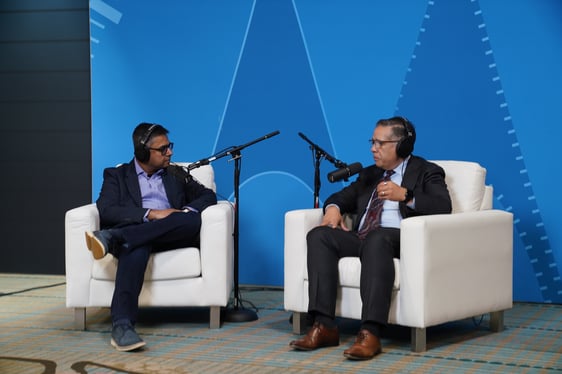
How Motorola Solutions is Building Smarter Public Safety with AI: Tech Disruptors
AI and Human Centered Design