
TABLE OF CONTENTS
loading...
As manufacturers embrace digital transformation, a fundamental truth remains: no innovation protects margins if plant-floor communications fail. Pairing a dedicated private radio network with broadband push-to-talk (PTT) creates a resilient communications backbone that safeguards continuous plant uptime.
In high-volume manufacturing, operational margins are defined second by second. Profitability depends on constant coordination across operators, maintenance crews and logistics teams. When communication breaks, lines halt and downtime costs accumulate.
Connecting personnel across expanding footprints is vital for peak productivity. While broadband PTT connects teams over cellular and Wi-Fi, industrial environments present dense structural steel, subterranean vaults and electromagnetic interference where standard wireless signals attenuate. Relying exclusively on unmanaged commercial networks introduces three critical vulnerabilities:
- Shared data contention: Broadband is engineered for data and video. Frontline containment requires dedicated channels for sub-second voice – ensuring emergency dispatches never compete with data-heavy applications.
- Dependence on external infrastructure: Commercial cellular and facility Wi-Fi rely on commercial power grids and off-site links. During severe weather or regional blackouts, operations without on-site, battery-backed infrastructure lose frontline coordination.
- Hardware limitations in challenging environments: Commercial devices cannot suppress industrial roar exceeding 100 dB and lack intrinsic safety certifications for hazardous locations, risking dropped dispatches and safety violations.
To overcome these vulnerabilities, facilities require a two-tier operational foundation. Establishing a dedicated private radio network guarantees sub-second voice penetration through heavy structural barriers, while layering broadband PTT adds wide-area reach across distributed teams, uniting floor-level certainty with enterprise-wide collaboration.
Maximize operational continuity and efficiency
Maintaining overall equipment effectiveness (OEE) requires unbroken coordination from assembly lines to shipping docks. Unifying a private radio network with broadband PTT protects margins:
- Instant dispatch and maintenance response: Dedicated radio channels connect frontline technicians instantly. When machinery stops unexpectedly, teams contain stoppages immediately – preventing localized jams from halting overall plant throughput.
- Technical troubleshooting: Frontline operators use private radio for instant voice coordination while transmitting machine diagnostics to remote specialists via broadband PTT, resolving complex equipment failures without delaying line recovery.
- Cross-fleet coordination: Interoperability gateways connect frontline radio channels directly with logistics teams on broadband PTT, synchronizing dock-to-floor handoffs without network contention.
Safeguard personnel with failsafe protections
With 45% of manufacturers citing labor shortages as their primary growth constraint, leaner crews must cover expansive facilities. Resilient communications protect workers:
- Lone-worker distress alerting: Two-way radios detect falls or lack of movement ("man down"), automatically transmitting priority distress alerts and precise coordinates to accelerate medical response.
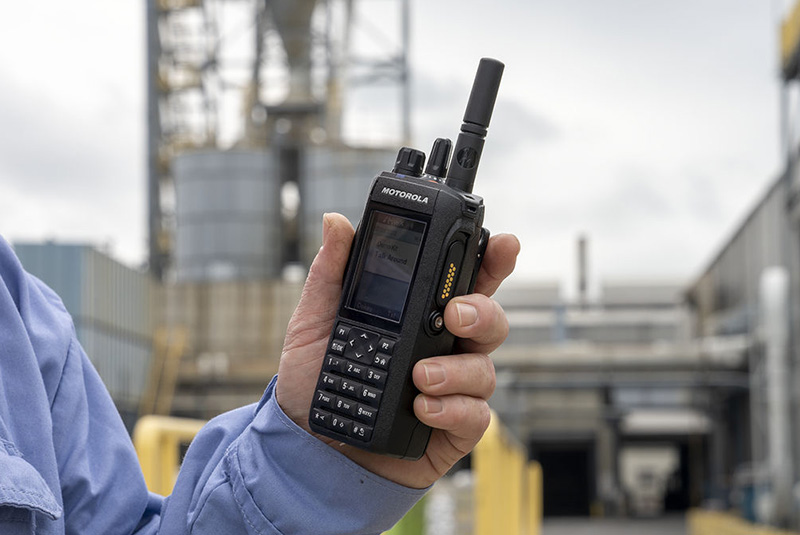
- Purpose-built, intrinsically safe hardware: Industrial radios certified to UL TIA-4950 and CSA standards eliminate ignition risks in Class I, II and III hazardous environments, while dual-microphone noise suppression cancels up to 120 dB of compressor roar so critical commands are heard.
- Wide-area safety escalation: Emergency alerts initiated on plant radios automatically bridge to broadband PTT devices, instantly alerting off-site supervisors and safety directors.
Secure facility perimeters and physical assets
Expansive plant boundaries and unstaffed areas require constant vigilance to prevent theft and trespassing. The integrated communications backbone bolsters security:
- Localized yard coordination: Security personnel, gate attendants and indoor operations remain synchronized over dedicated radio channels that eliminate outdoor coverage dead zones.
- Rapid incident dispatch: Supervisors broadcast priority alerts simultaneously across radio and broadband PTT, alerting on-site security guards instantly while notifying off-site managers during perimeter anomalies.
- Cross-network security communication: Gateways bridge private radio channels with broadband PTT networks, enabling supervisors to broadcast priority alerts simultaneously to on-site guards and mobile executive teams during perimeter anomalies.
The multiplier effect of voice, video and software
Unifying voice, video monitoring, environmental sensors and incident software into a single ecosystem eliminates blind spots and automates compliance:
- Proactive AI video and sensor detection: Edge-AI cameras spot perimeter breaches while environmental sensors track gas leaks or thermal spikes, triggering automated text-to-speech voice alerts directly across radio channels.
- Automated access control and license plate recognition (LPR): LPR verifies delivery freight at gates, while physical access barriers automatically lock down high-risk zones during active security alerts.
- Resilience workflows: Incident management software deploys pre-programmed response playbooks, dispatching step-by-step containment checklists directly to radios and mobile devices.
- Audit-ready compliance: Integrated systems archive chronological, tamper-proof logs of voice dispatches, sensor triggers and facility access events for regulatory reporting.
Safer manufacturing
Explore how we power safer manufacturing with unified voice, video, data and security solutions to protect your operations.Building a failsafe operational foundation
Continuous manufacturing operations demand the uncompromising reliability of a dedicated private radio network to guarantee instantaneous facility-wide voice penetration unaffected by carrier congestion or power outages.
Once that voice foundation is secured, layering wide-area broadband PTT extends collaboration across distributed teams. Integrating further ecosystem solutions – such as edge-AI video and automated incident workflows – extends visibility across your entire enterprise without expanding operational risk.
Transform your plant-floor communications into a driver of operational uptime. To assess whether your network meets industrial resilience standards, reach out to our team.