March 25, 2026
Technical Insights: A Comparative Assessment of TETRA vs. LTE-Based PPDR Networks
This independent report by Analysys Mason provides an evidence-based comparison across three vital pillars: coverage physics, architectural resilience and mission-critical features while also looking at global trends.
Key insights for public safety leaders:
- Physics of coverage: An in-depth analysis of coverage capabilities, focusing on propagation physics and delivery readiness.
- Purpose-built resilience: A comparative look at network resilience, architecture and operational delivery during crises.
- Critical features: An evaluation of special features critical to users, such as direct mode and ground-to-air communications.
- Global trends: Independent analysis concluding why TETRA remains the benchmark for mission-critical voice for the foreseeable future.
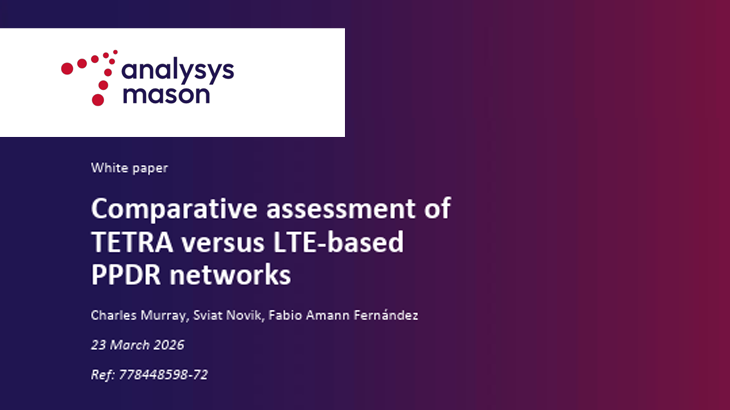
Read the full white paper here
Voice communications are fundamental to emergency services’ day-to-day work. When seconds matter, responders need a system they can trust without hesitation. Airwave was designed specifically for mission-critical voice. That means reliability, priority access and security are built into the system from the outset.
Airwave’s world-leading mission-critical communications service over the last decade (2016-2026):
- 3.4 billion calls: The total volume of mission-critical voice connections facilitated.
- 930,869 calls per day: The average daily load across the U.K.
- 38,786 calls per hour: A constant operational drumbeat.
- 741,000 emergency button activations: The ‘red button’ remains the ultimate safety tool.
- Every 7 minutes: The average interval at which an emergency worker in distress relies on the network to clear the path for a life-saving call.
- 3,652 days of achievement: The network hit or exceeded the gold-standard 99.5% availability threshold every day for a decade.
As mission critical communications evolve, understanding the technical and operational differences between established TETRA and emerging LTE-based platforms is critical for frontline resilience.